Space and Physics
 PUBLISHED


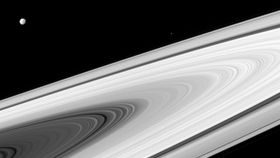


The Cassini mission is a scientific triumph that has profoundly transformed our understanding of Saturn and its moons. It has produced incredible pictures of the "lord of the rings", but there is quite a conspicuous feature missing from the images: stars.
The reason for the lack of stars is actually quite simple – the rings and the moons of Saturn are just too bright for Cassini's wide-angle camera. If the probe was also aiming to photograph stars, the rings and moons would saturate the pictures.
But before somebody claims that the pictures were created by Annie Leibovitz in a Hollywood studio, Cassini can actually take pictures with both moons and stars.
For example, image PIA10526, shows Enceladus surrounded by numerous stars. This was possible because the moon was undergoing an eclipse and thus allowed a longer exposure.
The Cassini spacecraft has been orbiting Saturn since 2004, and it will finish on September 15, 2017, when it will have a controlled dive into Saturn.
(H/T: NASA)