Culture and Society
 PUBLISHED
 2
2


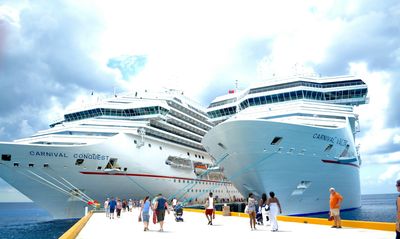


Have you ever noticed how cruise ships and luxury yachts are almost always painted white, while massive cargo ships come in a variety of colors, and military warships stick to a dull, somber grey?
The characteristic white hull of cruise ships is partially a matter of aesthetics. An all-white ship can look clean and classy, adding to the luxurious vibe that many consumers will be looking for.
Good looks and maritime tradition aren’t the only concerns – reflection and heat are also important considerations.
Since white reflects all the wavelengths in the visible spectrum of light, it absorbs less heat and stays cooler. This is especially important for cruise ships and luxury yachts that often sail in warmer climates, allowing them to rely less on air conditioning, which requires lots of energy (and money) to cool down hundreds of cabins.
It’s a similar reason why commercial aircraft tend to come in white. However, with both ships and planes alike, many companies are starting to break these rules by opting for more inventive color palettes, hoping to reinforce their brand identity and stand out from the crowd.
If any part of the sailing vessel does have added color, it’s usually the bottom of the hull, generally in a navy or red color. Once again, this is likely associated with maritime traditions and aesthetics, but it also does a good job of hiding the rust and other discolorations that can occur in places where the ship meets the waves.
Another idea is that the white helps the cruise ship stick out against the blue backdrop of the ocean and sky, offering a spectacle to passing observers and would-be customers.
It’s for precisely the opposite reason that navy warships are typically painted gray or muted blue: to blend into the sea and reduce their visibility to eagle-eyed enemies.
In the era of World War One, ships of the British Royal Navy and the US Navy played around with the concept of “dazzle camouflage.” Vessels were painted with black and white stripes and angular shapes with the aim of disrupting enemy calculations by breaking up the ship’s outline. Instead of trying to make a ship invisible, dazzle camouflage was designed to confuse a submarine’s periscope operator by distorting key visual cues – like its speed and distance – thereby making it tougher for an attacker to accurately target.
A few naval camouflage designs are still inspired by this idea, but most have returned to simple grey or blueish-grey color schemes, a tradition that dates back thousands of years. It’s said that the scout ships of Julius Caesar during the Gallic Wars were painted “Venetian" blue because of its camouflaging qualities – and it’s safe to say he knew a thing or two about military conquests.