Nature
 PUBLISHED
 1
1


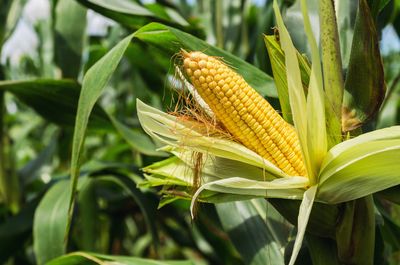


Corn is a relatively ancient crop; humans began selectively breeding its wild ancestor teosinte in Mexico over 9,000 years ago. Roughly 1,500 and 2,000 years after this, partially domesticated corn varieties continued to spread to Central and South America respectively. But as this popular crop developed, so did its etymology, and now, despite looking nothing like the ears on our heads, both have somehow ended up being called the same thing.
Also known as maize, corn is an edible grain in the grass family Poaceae. But corn isn’t just good at getting stuck in your teeth, it’s also used in livestock feed and even biofuel, making it one of the world’s most widely distributed and productive food crops.
While maize was the name given in the crop’s native home, the British would use the term “corn” to refer to all grain types, while the American colonies would refer to it as “Indian corn”.
However, the word “ear” is used to refer to a specific part of the plant. With stalks that can reach up to 3 meters (10 feet) high, the male and female parts of the plant both produce the corn cob. The sprouting top of the stalk is the male part of the plant, while the female flower is what grows the ear, which is comprised of kernels and enveloped inside a husk.
But what’s it got to do with an ear?
In a sort of convergent evolution, the taxonomy of both “ears” derived from different sources and ended in the exact same place. The ears that we hear with have an origin in the Old English eare meaning, you guessed it, “ear”. This can be traced back to the same meaning in Proto-Germanic (auso), but the Proto-Indo-European origin of auso is hews, meaning “to see”, which may also be linked to the term for “observe”, keu.
Ear as a part of corn, however, has a root in Proto-Indo-European ak, meaning to be sharp, rise out to a point, or pierce. This, in turn, helped shape the Proto-Germanic akhuz, meaning spike or ear of grain, and from there the Northumbrian Old English æher, and Wet Saxon ear.
The Oxford English Dictionary's definition of ear in this context is "the part of a cereal plant which contains its flowers or seeds," meaning the term can refer to the ears of other grains like barley, wheat, and even rice.