Health and Medicine
 PUBLISHED


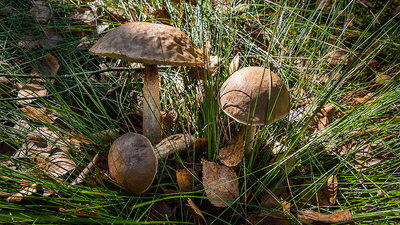


Magic mushrooms, the psilocybin-containing fungus that causes a psychedelic experience in people who take it, are pretty weird. Common themes on "trips" include a profound feeling of connectedness to nature, altered perceptions of time, and the dissolution of the ego.
Why this compound evolved in magic mushrooms is something scientists are still puzzling over. What is it about psilocybin, the active compound in magic mushrooms, that helps the mushrooms themselves to survive? Some have pointed to the idea that it is simply a defense mechanism against invertebrates. Others, that the compound alters the minds of animals that consume it, allowing for better dispersal of the fungal spores, once they have made their way through the animal's body.
But a mushroom that may take a little more explaining – or may reveal a little more about how our minds work, and are altered by taking various substances – is Lanmaoa asiatica: the mushroom that makes you hallucinate tiny people running about the place 6-24 hours after ingestion.
Hallucinogenic bolete mushrooms have been known to people in Yunnan province, China for an unknown period of time. One Daoist text from the third century CE refers to a "flesh spirit mushroom" which, when ingested raw, allows the taker to "see a little person" and "attain transcendence immediately", which may be in reference to the mushrooms.
The mushrooms are certainly known in the region now. Yunnan is host to around 40 percent of the world's wild edible fungi, but one, known locally as jian shou qing, comes with a bit of a warning. People do eat the mushrooms – in fact, they are mainly consumed as a food – but they must be stir-fried for 10 minutes (or 20, depending on who you are talking to) or you will see the "xiao ren ren", or little people.
People of the region do not appear to seek out the hallucinogenic effects of the mushroom, according to David Arora, who visited in 1995 to attempt to gain samples of it. But according to records at the Yunnan Hospital, around 96 percent of people who do experience hallucinogenic effects from undercooked mushrooms went on to see the xiao ren ren.
So, what are these mushrooms like to take? According to locals who spoke to Arora, most experiences were fairly benign, though of course it's still unusual to see small people scuttling around you.
One man explained that he had finished eating at a restaurant, when he noticed some moving colors and shapes in his vision. He wasn't too concerned as he knew of the mushroom's effect, and assumed that they had been undercooked. In fact, he was excited to have a chance to see the xiao ren ren, and was disappointed that he couldn't find them.
"But then, I don't know why, I lifted the tablecloth just a little and peeked under – ohhhh – a lot! Hundreds of xiao ren ren, marching like soldiers. And even more curious, when I lifted the tablecloth higher the heads came off and stuck to the bottom of the cloth and the bodies kept marching in place," the man explained, per a paper by Arora.
The man kept an eye on the xiao ren ren, as well you might, lifting the tablecloth at regular intervals. Every time he peeked under the tablecloth, there they were "marching and grinning" back at him. According to the man, he attempted to measure the hallucinations, finding them to be around 2 centimeters (0.8 inches) tall.
Another local described the time her mother cooked the mushrooms for the family, but not for long enough. According to her, her mother saw many of the little figures around the house, and attempted to chase and capture them. The girl saw no such human figures.
"It's better! I see xiao dongwu (little animals)! Many! I never see before. I never hear [of them] before," she told Arora. "And peacock. Front no, just the back. And when I close my eyes I saw it - more animals! I think maybe it's a dream!"
Tiny animals are not an uncommon hallucination either, with one review finding that all hospital patients admitted after taking the mushrooms reported tiny animals and humans running around in the real world, and when the patients had their eyes closed. While that might sound appealing, little is known about potential dangers of the mushroom, and not everyone's experience could be described as a good time amongst the Lilliputians.
"The seriously affected often have symptoms of toxic psychosis, such as auditory and/or visual hallucinations, disturbed thinking, and aberrant behavior, and may even become stuporous. Their clinical symptoms are very much like those of schizophrenia," the review explains, adding that they could become confused and panicky. "They would undress, beg for mercy on their knees, sneer at and quarrel with each other, or perhaps be unable to fall asleep and feel depressed."
The review describes two noteworthy cases of mass hallucinations caused by the mushrooms. In one instance, 50 workers at a factory were affected by the mushrooms, and in another 18 students and a teacher at Chuxiong Medical School ingested undercooked mushrooms and "began to quarrel among themselves".
Talking to others in the region, Arora found that they generally do not place much significance on the mushrooms or the little human figures grinning away under tablecloths. They are simply a food that, if prepared incorrectly, produces some strange effects.
Little is known about the compound that produces this strange effect, but interestingly the mushrooms have been found elsewhere in the world. Colin Domnauer, a PhD student in the College of Biological Sciences at the University of Utah, heard reports of people in the Philippines' Northern Cordillera consuming mushrooms with similar effects. Heading there to collect samples and DNA sequencing them, the team found that they were Lanmaoa asiatica, the same species as is consumed in Yunnan.
"That the same peculiar hallucinations are independently reported across such distant cultures indicates that these bizarre psychological effects are not cultural fabrications or coincidences, but manifestations of a shared underlying chemical and neurological basis," Domnauer explained in a piece for the Natural History Museum of Utah. "Lanmaoa asiatica appears to harbor a chemical compound capable of reliably evoking this unusual experience of lilliputian hallucinations. The discovery of that chemical may, in fact, hold the key to understanding one of the most mysterious dimensions of the human psyche."
At the moment, little is known about the compound responsible for these odd hallucinations, with the mushroom only being described by science for the first time in 2014. With renewed interest in the mushroom and its strange properties, hopefully that won't be the case for long.