Nature
 PUBLISHED


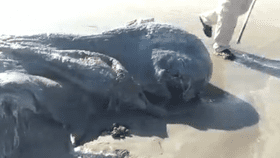


If you’re heading down to a Mexican beach for Spring Break or a holiday this month, be warned – "The Blob" is back.
This grayish 4-meter (13-foot) "gloop" was found in the southwest of Mexico at Bonfil Beach, Acapulco last week.
A video was shared on Facebook by the Protección Civil y Bomberos de Acapulco and has since been causing speculation on what it could be. Many people believe it could be the rubbery remains of a giant squid, while others are wagering on it being the remains of a whale. Oddly, there was no foul odor coming from the mess, suggesting that it was not far into decomposition and it had died relatively recently.
Live Science chatted to James Mead, a curator of marine mammals at the National Museum of Natural History in Washington, D.C. who said it was likely to the top part of a sperm whale’s head.
These cetaceans can grow up to 18 meters (59 feet) in length and, proportionally, have a sizable head that they use for echolocation. Within the forehead there is an area called the "melon," or occasionally the "junk," which is a fatty ball of adipose tissue. Mead explained to Live Science that the video reveals a few characteristics, such as a nasal plug around halfway through the video, which suggests it is indeed a whale’s melon.
Protección civil y Bomberos de Acapulco Reporta, un animal marítimo desconocido hasta el momento, en las playas de la bonfil.
Posted by Protección Civil y Bomberos de Acapulco on Wednesday, 9 March 2016