Space and Physics
 PUBLISHED


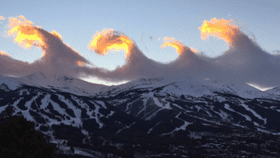


They look like swirls that have come straight off Van Gogh's paint brush. However, what you see above is actually an amazing phenomenon called the Kelvin-Helmholtz instability.
The Breckenridge Resort in Colorado tweeted the image a few days ago, showing a gorgeous example of turbulent fluid dynamics. This intricate pattern emerges in clouds when two different layers of air in the atmosphere are moving at different speeds and have different densities. Where these two layers meet there is a sheer layer that becomes unstable by the discontinuity of speed. This causes a vortex and small wave-like patterns to break out, which build and build to create these larger billows.
They were named after the 19th-century physicists Hermann von Helmholtz and Baron Kelvin. It’s a pattern you can see in many different areas of nature and astronomy, most notably in the ocean and clouds, but also on Jupiter's Red Spot and the Sun's corona.