Space and Physics
 PUBLISHED



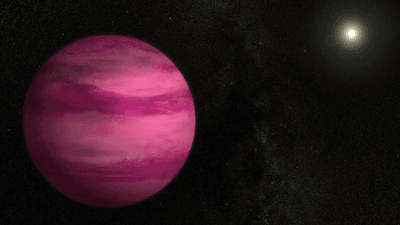


In 2013, researchers discovered GJ504b, an object orbiting star GJ504 in the constellation Virgo. To the naked eye, this world would look a truly unique magenta color and, for that reason, was nicknamed the Pink Planet. Now, new research from JWST has revealed some other possible quirks and is even challenging whether this celestial body is a planet at all.
Previous estimates placed the mass of GJ504b at around four times that of Jupiter and suggested the system ought to be young, maybe 160 million years old. The new JWST observation challenges both those facts.
The new work estimates that the planet is between 2.5 billion and 4 billion years old, and its mass is around 25 times that of Jupiter. This places it in the peculiar category of “planetary-mass companion.” Did it form like a planet? Or is it a failed star object, AKA a brown dwarf? We don't know.
What we do know is that, despite its size, GJ504b is (relatively) cold. Planetary-mass companions form very, very hot and slowly cool as they age. The Pink Planet has a temperature of just 290°C (550°F), and while that's as hot as a bread-baking oven, it's small potatoes for this kind of celestial object.
“The Pink Planet is the coldest companion ever discovered using ground-based instruments,” lead author Aneesh Baburaj at Northwestern University in Illinois said in a statement. “Many teams all around the world performed follow-up observations to study its light, but it was too faint for ground-based instruments. That made it a perfect target for JWST.
"When we finally obtained its spectrum, it immediately looked interesting. But once we started digging deeper into the data, we realized it was not like anything we have analyzed before.”
The JWST observations reveal a trove of interesting molecules. These include water vapor, methane, carbon dioxide, and ammonia, among many others. But when the team modeled the atmosphere, they kept receiving odd and implausible results.
To solve the mismatch, the researchers had to add clouds to their model, and it turned out that the best models incorporated a peculiar type of cloud that had never been seen before.
“We ran simulations with clouds, and the results aligned with what we know about cold planets,” Baburaj said. “We tried three different types of clouds, and salt clouds fit best. When we accounted for salt clouds, it subdued the signature of molecules hidden deeper in the companion’s atmosphere. Then, the results became physically possible.”
The idea of salt clouds on exoplanets isn't new. It was put forward, for example, to explain another weird exoplanet, GJ 1214 b, back in 2015. More recent observations by JWST, however, suggest that planet's oddities are better explained by the presence of a kind of haze rather than clouds.
“This is the first time we’ve found that salt clouds are critical to explaining the spectrum of an object,” Baburaj concluded. “It’s a good reminder to account for clouds in our models.”
A paper describing the results is published in The Astronomical Journal.