Space and Physics
 PUBLISHED



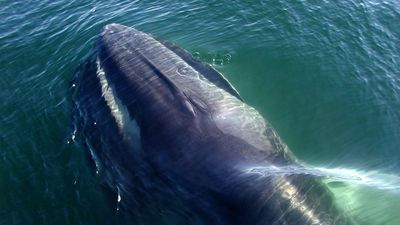


The deep calls of the great whales can be heard far across the oceans, but when Dr John Spiesberger at the University of Pennsylvania tried to measure the speed of fin whales' sound waves, his answers confused him. Eventually he worked out that two waves were combining, distorting the apparent speed of the signal, an effect best known from a paradox in Albert Einstein’s special theory of relativity.
Knowing the speed of a whale’s call allows us to calculate its maker's position, which is useful if you want to do biological research on it. (Whales presumably have their own reasons to want to know the locations of other members of their species.) However, Spiesberger’s program of estimating speed from detections at multiple recording devices produced apparently nonsensical results.
“The first time, we got a number that was around 1,000 meters per second,” Spiesberger said in a statement. The usually quoted figure for sound in seawater is 1,500 meters per second. “And then, further on, I got values that were sometimes 3,000 meters per second. I immediately thought there was a bug in my program.”
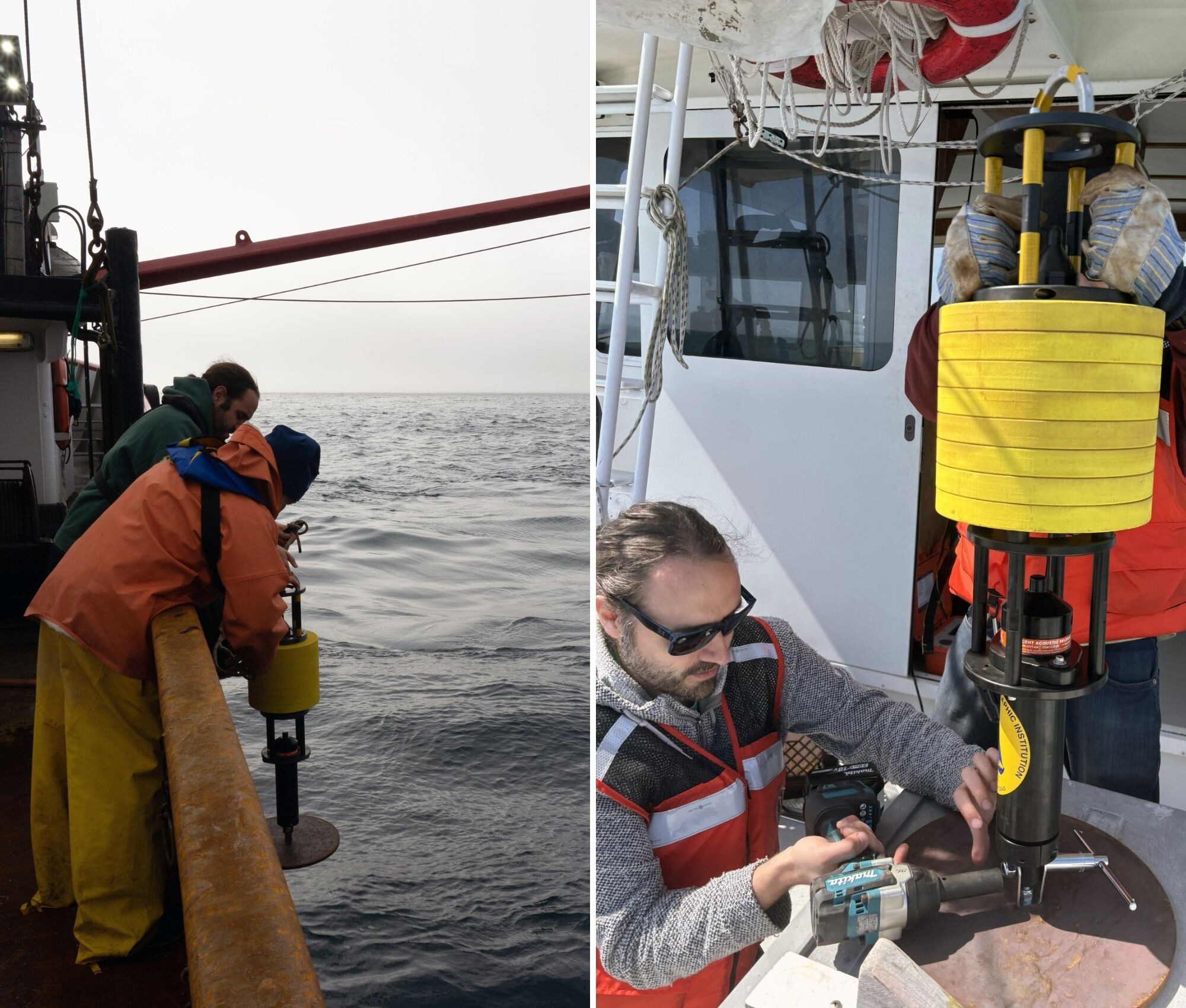
Eventually Spiesberger realized the contradictions were because some of the sound waves are travelling directly to the receivers, while others are bouncing off the surface of the ocean and therefore taking a longer path. That in itself isn’t new; we’re all familiar with the way echoes can reach us on delay.
However, what Spiesberger and co-author Dr Eugene Terray at Woods Hole Oceanographic Institution in Massachusetts were detecting was due to how these signals combine, producing "temporal interference." Older readers will be familiar with the effects of this from the way radios or televisions could lose signals when radio waves arriving by different routes interfered with each other. Younger readers can ask their parents.
A curious aspect of temporal interference is that an energy peak can arrive earlier than would be expected from either signal alone. “The effect sounds like a violation of physics,” Spiesberger said. “But it isn't.”
The connection to Einstein is that special relativity is frequently described as stating that nothing can travel faster than the speed of light in a vacuum. Physicists are always up for a challenge, and immediately sought exceptions. Aside from the possibility of tachyons, particles that always travel faster than light, special relativity doesn't rule out the possibility that electromagnetic waves can combine so that a signal peak travels faster than light. This is even though the photons themselves continue to move at light speed.
Crucially, however, this peak carries no information. If it did, it would be possible to send information back in time. “You can’t use this trick to send a message to your past self to bet on the stock market,” Spiesberger said. “Causality isn’t overturned.”
The idea of an energy peak moving faster than the wave that carries it may seem nonsensical, but one can visualize a somewhat analogous situation where an ocean wave runs into a wall at an angle. The crest will hit one end of the wall first and then run along the wall as more and more of the incoming wave encounters it.
Depending on the angle between them, the location where the wave’s crest is in contact with the wall can move faster than the wave itself. Repeating the thought experiment with a beam of light replacing the ocean wave, the point of illumination can propagate along the wall faster than the speed of light while carrying no information that would violate Einstein’s theories.
However, while some physicist lecturers have liked to mention this possibility to make their students’ brains hurt, it only occurs in very restricted circumstances, which don’t occur often in nature. At least that is true for light waves – it seems whales have been creating temporal interference in sound waves for millions of years.
Moreover, while the basic concept has been known for a century, there’s still a lot that hasn’t been explored about how the effect works. Last year Spiesberger and other authors published a paper on the way related effects can slow the speed of sound, using what they call the “three-dimensional effective speed” of the peak energy packet. Now Spiesberger and Terray have provided a more rigorous mathematical description of the physics of how temporal interference can create apparently supersonic and superluminal energy movement.
Although Spiesberger is confident that temporal interference is the reason his whale calls appear to be moving at different speeds, he still feels the need to demonstrate it experimentally. He plans first to bounce sound waves off a hard floor, and combine them with those that travel directly to the receiver, hopefully producing upside down models of what the whales are doing. Then he wants to do the same thing thousands of times faster using lasers.
The study is published in Physical Review E.