Space and Physics
 PUBLISHED


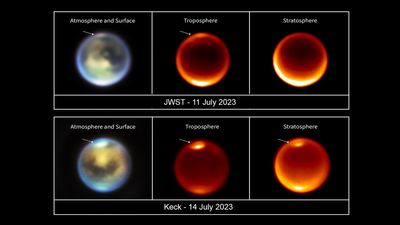


Titan, the largest moon of Saturn, is the only other world in the Solar System with rivers, lakes, and seas on its surface. They are not made of water, as it is far too cold there, but hydrocarbons, mostly methane. Earth has a water cycle that moves the liquid around between the ground and the atmosphere, and Titan has a similar methane cycle, which means rain happens on Titan. Only, it's methane rain. Now, JWST and the Keck Observatory have spotted cloud behavior indicating possible showers.
The two observatories, one in deep space and the other in Hawai’i have observed clouds in the northern hemisphere of Titan – currently in summer – moving to higher altitudes, a type of convection that has been observed in the southern hemisphere in the past. The reason is believed to be rain on the vast methane lake existing in the region.
“Titan is the only other place in our Solar System that has weather like Earth, in the sense that it has clouds and rainfall onto a surface,” lead author Conor Nixon of NASA’s Goddard Space Flight Center said in a statement.
The observations by JWST have revealed a crucial chemical step in the formation of different carbon-bearing molecules in the atmosphere of Titan. The space telescope found the methyl radical CH3, which forms when methane is broken apart by sunlight or electrons thrown around by Saturn’s magnetosphere, and then ends up forming larger carbon molecules.
“For the first time, we can see the chemical cake while it’s rising in the oven, instead of just the starting ingredients of flour and sugar, and then the final, iced cake,” explained co-author Stefanie Milam of the Goddard Space Flight Center.
In the formation of the methyl radical, methane loses a hydrogen atom, and that hydrogen can escape the atmosphere. If there is no source of hydrogen, then eventually the atmosphere will disappear. But we do not know enough about Titan to be sure.
“On Titan, methane is a consumable. It’s possible that it is being constantly resupplied and fizzing out of the crust and interior over billions of years. If not, eventually it will all be gone and Titan will become a mostly airless world of dust and dunes,” said Nixon.
We will certainly know more about Titan, including its potential for habitability, when the Dragonfly mission arrives there in 2034, flying around the moon. It will be the second-ever flying vehicle on another world after Ingenuity when it does.
The study is published in the journal Nature Astronomy.