Space and Physics
 PUBLISHED
 2
2


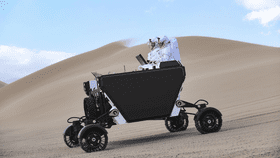


Chris Hadfield is once again living out all of our wildest astronaut fantasies by test driving a full-sized lunar rover through Death Valley, in preparation for the rover eventually driving across the surface of the Moon and even Mars.
The full-scale prototype of the Flexible Logistics and Exploration (FLEX) rover was unveiled by manufacturer Venturi Astrolab in a video, before former astronaut Colonel Chris Hadfield, ex-commander of the International Space Station and multiple space shuttle missions, got to take the wheel and drive it across Nevada’s Death Valley.
As one of the closest resemblances of the inhospitable conditions in extraterrestrial environments, Death Valley gave the astronauts and California-based engineering company the perfect opportunity to trial their new rover.
Hadfield had a gleeful time racing (even if said race was a really, really slow one) around the arid landscape. "It was huge fun to drive FLEX today," he says in the video. "I mean, just a joy."
The main takeaway, however, was the success of the rover for traveling around. The FLEX rover is supposedly a flexible platform that allows for cargo movement, crew transport, and various other utility for missions on the Moon and Mars, with the unique selling point of being modular and adaptable for many different scenarios.
One of the things astronauts learned when they got to analog training sites is how important mobility is, Hadfield explains. With the Artemis mission to take humans back to the Moon already set to take place and talk of Moon – and possibly even Mars – habitats, being able to move people and things from one place to another will be more important than ever.
"To have a chance to drive that rover, to see its potential, it immediately appears in my mind's eye, something that looks a lot like this is going to be helping people out when we start to live on the Moon – and eventually Mars," Hadfield said.