Nature
 PUBLISHED


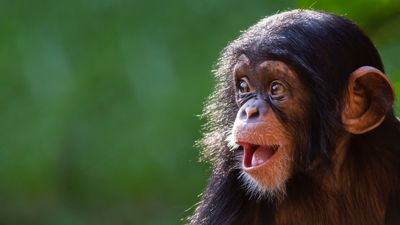


What separates us from animals that share 98.8 percent of our DNA? While there might be many varied and valid answers, something that has been at the forefront of this debate is the lack of speech from chimpanzees. Two theories exist as to why chimpanzees might not be able to make human speech sounds: either it is a physiological issue within the lips, tongue, or mouth system; or they lack the pathways in the brain to make a sound. However, by reviewing old footage, researchers have challenged the idea that chimps don’t have the building blocks for speech.
Animals have also been known to mimic human speech but are typically those without any similar vocal apparatus, such as whales and other marine mammals. In human babies, words such as “mama” are often among the first to appear. The team looked at old videos of two chimpanzees named Johnny and Renata who each produced the word “mama”. In the paper, the authors explain that Johnny lived at the Suncoast Primate Sanctuary at Palm Harbor in Florida, USA, and was recorded on a home video. When prompted by the question “Can you say mama?” Johnny appears to appropriately respond.
In Renata’s case, the footage came from a Universal Studios’ Universal Newsreel called Now Hear This! Italians Unveil Talking Chimp was released in 1962. However, the team does not know any further context surrounding Renata's life or how she might have been taught to speak.
They explain that previous research has been based on scientific studies (which nowadays would not pass ethical standards) on apes that experienced poor animal welfare – they explain that "Subjects in 'ape language' studies were traumatized, their emotional, ecological and social needs unmet", with many being taken from their mothers in the wild and exposed to "neglect and cruelty".
To test if unbiased people could tell what the chimps were saying, the researchers set up an experiment. The voices of the chimpanzees were mixed in with the voices of humans diagnosed with speech pathologies from Parkinson's disease. Each voice was saying only a few words, and the participants in the study were not aware that two of the voices came from chimps. They were asked to write down the words spoken during the experiment – if they wrote ma or mama, it would indicate that the phonetics the chimps were saying were similar to human words.
Most of the participants agreed that at least Renata was making “mama” sounds, while there were more widespread responses surrounding the noises Johnny was making. The results suggest that the chimps were capable of vocal learning. The team wrote that “chimpanzees can produce the putative 'first words' of spoken languages.” The team concluded that previously chimps have underestimated and do possess the necessary neural pathways for speech – "Great apes can produce human words; the failure to demonstrate this half a century ago was the fault of the researchers, not the animals," they conclude.
Not everyone is convinced though – as Julia Fischer, a cognitive scientist at the German Primate Center in Göttingen explained to the New York Times, “This paper is a good example of the tug of war in the ‘ape language’ field. What the apes are doing vocally has nothing to do with human speech,” she said.
The paper is published in the journal Scientific Reports.


 1
1