Space and Physics
 PUBLISHED
 1
1



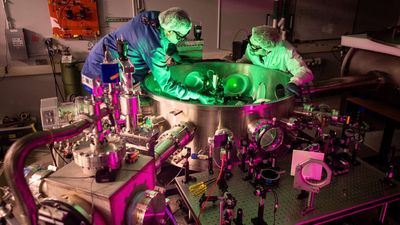


Researchers have built the USA's most powerful laser yet, so powerful that the only way to describe its power is to compare it to the world's annual consumption of electricity. The instrument, called ZEUS, is hoped to have applications in a variety of fields, from medicine to astrophysics.
ZEUS is the first official experiment that crosses the threshold of 2 petawatts (2 quadrillion watts). Given that the total annual human global power consumption is around 20 terawatts, that is 100 times as powerful. Still, it operates in pulses of just 25 quintillionths of a second long – that’s attoseconds or 10-18 seconds. So, it won’t be breaking the bank in terms of the electric bill.
The ability to reach petawatt-levels of power is outstanding, but the team has used some clever physics to make this already overpowered system 1 million times more powerful: reaching the zettawatt regime. ZEUS stands for Zettawatt-Equivalent Ultrashort pulse laser System, and has a clever geometry, where the powerful laser smacks into a high-energy electron beam. From the point of view of the electrons in the beam – their rest frame – they are being hit by a laser at zettawatt power.
“This milestone marks the beginning of experiments that move into unexplored territory for American high field science,” Karl Krushelnick, director of the Gérard Mourou Center for Ultrafast Optical Science, which houses ZEUS, said in a statement.
The laser doesn’t start its life with a tiny and extremely quick pulsation of light. It begins in infrared light, goes through diffraction gratings, and interacts with pump lasers. Across the system, the laser is given more energy, passing through a sapphire amplifier imbued with titanium atoms. It also changes size; from an initial 30 centimeters (12 inches) across, it is flattened down to 0.8 microns across – 10 times thinner than paper. That’s when the magic happens.
But this is not the end – new improvements will push the laser to even higher powers.
“The crystal that we’re going to get in the summer will get us to 3 petawatts, and it took four and a half years to manufacture,” said Franko Bayer, project manager for ZEUS. “The size of the titanium sapphire crystal we have, there are only a few in the world.”
Having an extremely powerful laser is not just for show; it allows the researchers to study materials and phenomena in, quite literally, a whole new light.
“The fundamental research done at the NSF ZEUS facility has many possible applications, including better imaging methods for soft tissues and advancing the technology used to treat cancer and other diseases,” said Vyacheslav Lukin, program director in the NSF Division of Physics, which oversees the ZEUS project. “Scientists using the unique capabilities of ZEUS will expand the frontiers of human knowledge in new ways and provide new opportunities for American innovation and economic growth.”