Culture and Society
 PUBLISHED
 1
1


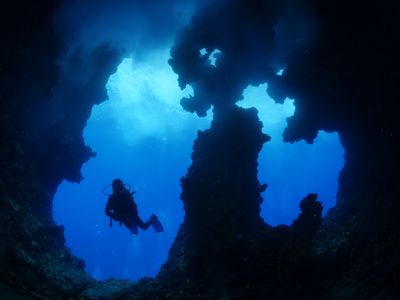


There is a well-known experience astronauts have when they first observe the Earth from low space. This phenomenon, known as the “overview effect”, is a distinct feeling of awe accompanied by a deeper appreciation for the planet’s interconnectedness. Now researchers have documented a similar cognitive shift, which they are calling the “underview effect”, that occurs among aquanauts – people who live and work under the sea.
But while this may seem like an interesting personal experience, the researchers actually believe it may have much broader potential for the public. In essence, if this sense of wonder and kinship with nature can be shared, it could help people appreciate the natural world more and support conservation efforts.
Aquanauts are a largely understudied population, though that may be because there are very few of them in the world (around 100 living members). They’re individuals who live and work underwater using special underwater laboratories as their home base. These underwater stations are designed to have pressure that is equal to the outside aquatic environment, which allows researchers to spend a far longer time scuba diving – sometimes over eight hours a day – without needing to stop to decompress.
Under normal conditions scuba divers can only descend to a depth of 60 feet for 45 minutes before they need to resurface. This obviously limits the amount of time they have to observe ocean life. In contrast, saturation divers – those who live under these specially pressurized conditions – can pack their decompression into 24 hours at the end of their stay.
The benefits of this type of experience are significant for studying this environment.
Consider it like this, suggested senior author Brian Helmuth, a marine and environmental studies professor at Northeastern University, in a statement: Imagine comparing the quality of observations made by someone like Jane Goodall, the world-renowned primatologist who was able to live in the forest and study chimpanzees, with those made by someone who was dropped into the location by a helicopter for 30 minutes at a time.
Awe below the waves
Anyone who has been scuba diving or snorkelled on holiday will likely have experienced a small measure of the awe that can come from even a short time spent underwater. Being underwater for extended periods of time can significantly amplify this sense of transcendence.
In order to study this effect, Helmuth and Kristen Kilgallen, a third-year PhD student at Northeastern University and the lead author, interviewed 14 aquanauts (one of whom is also an astronaut) about the psychological, behavioral, and cognitive changes they experienced living underwater for extended periods of time.
“Aquanauts have been very understudied,” Kilgallen explained. She added that this is a first-of-its-kind study, which goes beyond the physiological or safety implications of living underwater for multiple days or even weeks at a time.
In the research, Helmuth, Kilgallen, and colleagues showed that living underwater led to a heightened perception and amplification of the sense of commitment and connectedness to the natural world.
“A major shift occurred that was very similar to what astronauts experience, the overview effect,” Kilgallen added.
According to their results, 70 percent of respondents reported heightened awe and gratitude, and 64 percent reported increased engagement with their surroundings because of the challenges posed by living underwater.
But while both aquanauts and astronauts seem to share a view that everything is connected and interrelated, there was more of a sense of “connectedness to the specific marine environment”, Kilgallen said, “rather than the Earth as a whole.”
This research is a key step in developing a deeper understanding of not only the implications of living underwater, but also for appreciating the natural world more generally.
“We’re at this juncture where we’re realizing that a business-as-usual approach to how we interact with nature and especially the ocean is just not going to cut it,” Helmuth explained.
The oceans play a pivotal role in the life of creatures across the Earth. For instance, phytoplankton produce up to half of the world’s oxygen, so every breath we take is actually dependent on these marine organisms. And yet the world’s oceans are often simply treated as dumping grounds without any regard for the consequences.
“Unless we reframe the way we interact with the ocean, we’re in a lot of trouble,” Helmuth added.
The study is published in the journal Environment and Behavior.