Culture and Society
 PUBLISHED
 2
2


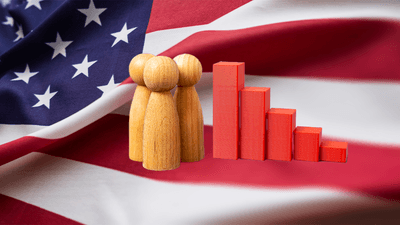


From big talk about annexing sovereign nations to myriad spitballed ideas to encourage birth rates, increasing the population of the USA has evidently been a high priority for the second Trump administration. So it’s with a heavy dose of irony that a slew of new figures and analyses now reveal a picture not of a country swelling at the seams, but one on the brink of shrinking.
“It’s not anything I expected to see. Let’s put it that way,” Jeffrey Passel, senior demographer at the Pew Research Center and veteran US demographer, told Bloomberg Friday. “We really haven’t seen anything like this.”
A modest census
The first surprise comes courtesy of the US Census Bureau, whose latest estimates for 2025 show a population growth of just 0.5 percent year-on-year – the equivalent of only 1.8 million new people.
That might sound like a lot, but it’s actually the smallest increase in population since 2020-2021, during the early days of the pandemic. It’s especially stark after the year between 2023 and 2024, during which the population grew by 3.2 million – an increase of 1 percent, and the fastest growth since 2006.
The main reason for that is simple: a huge decrease in net migration. Compared to the previous 12 months, that figure more than halved: it was “a historic decline,” Christine Hartley, assistant division chief for Estimates and Projections at the Census Bureau, said in a statement last week, in which “net international migration […] dropped from 2.7 million to 1.3 million in the period from July 2024 through June 2025.”
Meanwhile, the rate of natural increase – that is, births minus deaths – is only barely positive. At around 519,000, it’s roughly the same as the year preceding it – but less than half what it was a decade ago, and a quarter what it was in the decade between 2000 and 2010.
At that rate of decline, the natural rate is set to turn negative by 2030, according to the Congressional Budget Office (CBO), a federal agency responsible for providing Congress with nonpartisan budgetary and economic data. At that point, the US will be entirely reliant on immigration for population growth – which makes the year’s sharp decline in net migration all the more alarming.
A shrinking country
It was back in 2023 that the US Census Bureau last issued long-run forecasts for population growth. Things looked rosy: the country was set to grow, albeit at a slowing rate, until 2081. But three years on, things aren’t so optimistic: the CBO reckons that the US population will start decreasing in 2056 – and according to one study, released in mid-January, even that is a wild overestimate.
“Our analysis suggests that the United States experienced negative net migration in 2025 for the first time in at least decades,” concludes a press release from the public policy nonprofit the Brookings Institution. “We estimate net flows of –295,000 to –10,000 for the year.”
With around half a million more births than deaths in the country, that still counts as a small population bump. But the same can’t be said for the Institution’s forecast for 2026, where they project net immigration to be somewhere in between 185,000 and –925,000. Short of a sudden, unexpected, and unrealistically massive baby boom, that latter figure would guarantee what might be the nation’s first population decline ever – and definitely the first since 1918, when the global flu pandemic had hit the country, and some two million soldiers had been deployed overseas.
So, why such a bleak outlook? The CBO’s estimates are more hopeful: while they still have net migration levels at far lower than a few years ago, their prediction is that the numbers will grow to a steady 1.1 million or so over the next decade. But those figures are based on some assumptions that the Brookings team doesn’t accept: “The CBO estimate includes fewer deportations than our estimate,” they point out, “and CBO also assumes voluntary out-migration falls in response to increased enforcement activity, whereas we assume it rises.”
That latter assumption, at least, is backed up by a recent analysis by the New York Times: despite the Trump administration’s high-profile streak of ICE activity and deportations, the Times found that only about 230,000 people were deported from the US over 2025. That’s a big number, but much lower than the ones predicted by Brookings – hinting that a far bigger factor is people simply not wanting to be in the US right now.
Why people worry about population decreases
In a world where the demands of our species so hugely outweigh the ability of our planet to provide, perhaps you might wonder: why is a shrinking population bad?
Well, in a word: the economy. “Population growth helps GDP grow. It helps the labor supply grow,” Tara Watson, director at the Brookings Center for Economic Security & Opportunity and one of the study’s co-authors, told Bloomberg.
“There’s just a lot more grease in the economy when there’s some population growth as well.”
Overall, the Brookings study found that the effect of their predicted reduction in net migration could shrink the country’s GDP by more than 0.3 percent. The reason why, in simple terms, is this: fewer immigrants, who are usually of working age, means fewer people buying stuff – which means less economic activity overall.
And it’s not a small amount, either: we’re talking tens of billions of dollars each year, suddenly removed from businesses’ pocketbooks. “In our assessment, the reduction takes businesses by surprise,” the authors write, and “in response, those businesses take actions, such as laying people off, which have knock-on effects in reducing GDP.”
If a shrinking economy wasn’t bad enough, you can factor in the effect of fewer people of working age to fulfil jobs, more elderly people needing care, and the increased resource requirements of a rich, aged society. It’s not a hopeful outlook – so should the US be worried about this population fall?
The answer “depends a lot on whether this is a temporary blip or whether this is the new normal,” Watson said. If a new administration enters the White House in 2028 and ushers in a more welcoming atmosphere for immigrants, then “I don’t think the long-run economic implications would be huge,” she said, “[but] there’s also a world where this sort of gets us into a long-run low-migration environment.”
“I don’t think there’s anything magic about zero [population change],” Watson said. “But none of these things help the economy do the best it can do.”