Humans
 PUBLISHED
 3
3

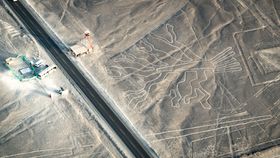


A truck driver left his own artistic impression on the 2,000-year-old Nasca lines in Peru, and let’s just say it’s not a pretty site.
After allegedly ignoring signs, 40-year-old Jainer Jesus Flores Vigo drove through the Unesco World Heritage site reportedly leaving the paved road to “avoid paying a toll”.
The man says he was unfamiliar with the area.
Peru’s Ministry of Culture, who is working with the Prosecutor’s Office, says the truck significantly damaged the area, leaving “deep scars” on the surface and part of three geoglyphs – a total area of about 50 by 100 meters.
The Nasca Lines has long been a source of awe and mystery.
Located about 400 kilometers (250 miles) south of Lima, the Nasca Lines are an arrangement of geometric lines – most famously a hummingbird, monkey, and a spider – that were scratched into the surface of the earth between 500 BCE and 500 CE. They cover an astonishing 725 square kilometers (280 square miles) and were believed to have had ritual astronomical functions. One of the reasons they are so mysterious is that they are only visible from above, giving rise to questions about how the Nasca people created such comprehensive drawings without being able to see them.
Deemed a Unesco World Heritage site in 1994, Unesco has said the lines are “among archaeology's greatest enigmas.”
A place is designated a World Heritage site upon selection by the United Nations Educational, Scientific and Cultural Organization (UNESCO) because of its “outstanding universal value.”
Unique and diverse sites are located all over the world – from East Africa’s Serengeti to the Pyramids of Egypt, all the way to the Great Barrier Reef in Australia – these places are some of Earth’s most valuable and natural assets.
Unfortunately, this sort of thing isn’t out of the ordinary.
A 2017 study published in Biological Conversation suggests these sites are facing increasing pressures from humanity and more than half across all continents (except Europe) are rapidly deteriorating
Syria, for example, once had six Unesco World Heritage Sites. Now, all have been damaged or destroyed in the civil war, including Aleppo’s famous Umayyad Mosque Complex.
Just last year, as much as 93 percent of Australia’s Great Barrier Reef experienced coral bleaching – the worst bleaching event on record.
The list goes on.
While there is international recognition of these sites, it falls upon their home nations to enact penalties on those who damage or destroy them.
In the case of the unaware truck driver, the magistrate said there is not sufficient evidence to say he acted intentionally. The ministry sought nine months of preventive detention and $1,550 fine while the investigation continues, reports Peru 21.