Culture and Society
 PUBLISHED
 2
2


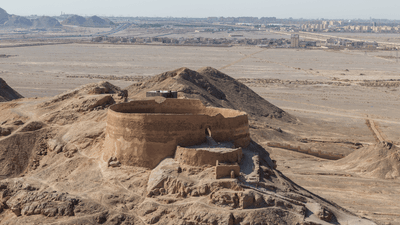


Humans have been burying their dead for millennia, but it’s not the only way we’ve utilized nature to help us transform corpses. In Tibet, birds of prey play a pivotal role in Sky Burials, and elsewhere, Zoroastrian tradition saw the erection of Towers Of Silence, a place where corpses are arranged so that carnivorous birds can feed on them.
The funerary practice is seen as a way of purifying the body, as without it, a corpse is vulnerable to contamination by demons or evil spirits. To stop that from happening, the dead were taken to towers known as dakhmas so that they could be exposed to the elements and winged scavengers.
You might imagine it to be a messy, lengthy process, but a study using donated human remains at the Forensic Anthropology Research Facility in Texas has shown how vultures can largely skeletonize a corpse in just five hours. Five! In a coffin, you’re looking at closer to five years for the same results, so those birds really know what they’re doing.
Like Sky Burials, Towers Of Silence avoided the negative consequences of modern day burials that have taken up around 1 million acres (404,685 hectares) of land in America, with the production of caskets destroying roughly 4 million acres (1.6 million hectares) of forest annually. Many of those bodies go down having been embalmed, committing around 800,000 gallons of embalming fluid to the ground, which can leach into the soil as a contaminant.
There was a time you could find active Towers Of Silence in several places across the globe, with The Guardian reporting that the practice dates back at least 3,000 years. For orthodox Zoroastrians, the idea of burial is so abhorrent that it was reportedly considered a form of punishment for the wicked. This is because it created an obstacle that prevented the soul from ascending to heaven, leaving it doomed to spend eternity in the underworld.
Zoroastrian communities (whose members are known as Parsis) still exist today but the number of dakhmas has dropped significantly as the practice has been outlawed in parts of the world. Even in places where they are still legal, the Towers Of Silence are struggling due to a fall in the number of vultures.
“Because of the rapid growth of metropolitan Karachi, the daḵma, once on the edge of town, is surrounded by densely populated neighborhoods, and there have been no vultures for 25 years," explains Encylopaedia Iranica. "The bodies dry quickly in the hot sun of Sindh but are not stripped of their skin and have crowded the daḵma, whose pit cannot handle their bodies.”
The practice might seem shocking to Westerners where burial has always been the norm, but it could be argued that dakhmas are better for the planet, and carry a comforting final act of charity as the flesh feeds the vultures that assist the soul’s transition to heaven. On a planet where the population has tipped 8 billion, perhaps it's time to start taking ecologically sound funerary practices more seriously, and on that note, have you heard about human composting?