


 Space and Physics
 PUBLISHED


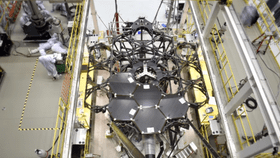


When finished, the James Webb Space Telescope (JWST) will be the most powerful orbiting observatory ever created by humanity. But how do you go about trying to construct this monstrously advanced star gazer?
In this timelapse video you can gain an insight into how the teams of engineers and technicians pieced together just one phase of this massive project, with a surprising amount of physically intensive handy work (and lying on the floor).
To create this video effect, photographer Chris Gunn and producer Michael McClare took one image every 30 seconds for 83 days in the times they were working, between November 11, 2015, and February 1, 2016.
With the help of a hefty machine, 18 hexagonal mirror segments are put into place, each of which weighs 40 kilograms (88 pounds). Once fully deployed, this 6.5-meter-wide (21.3 foot) black honeycomb will be the primary mirror that will collect and harness light for the telescope.
While the completion of this segment is a major milestone in the telescope’s completion, NASA says it’s only the beginning.
Bill Ochs, JWST project manager, said in a NASA statement: “Between now and early 2017 will be the most significant year to date in the integration and test of Webb.
“Each of the four major elements, the telescope, science instrument package, spacecraft bus, and sun shield, will be delivered and will be integrated into the two major pieces which make up the observatory," he added.
The JWST is the “scientific successor” to NASA's Hubble Space Telescope. NASA, the European Space Agency and the Canadian Space Agency hope to launch the telescope from French Guiana in October 2018, where it will begin unravelling the formation and history of our universe.


