


 Health and Medicine
 PUBLISHED



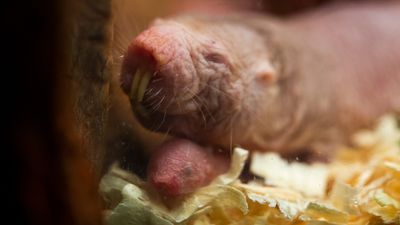


It seems everyone wants to live well forever these days, and they’re willing to do anything to make that happen. Magic mushrooms? Going to space? We’ll throw anything at the wall, including naked mole rats.
The naked mole rat, Heterocephalus glaber, is something of a superhero when it comes to longevity. They live longer than any other rodent, and what’s more, they do so without getting sick as they age. They don’t get cancer, and they can continue producing offspring their entire lives. No wonder, then, that scientists are turning to naked-mole-rat-maxxing.
It’s thought the naked mole rat’s resistance to aging centers around a gene vital to the production of high-molecular-weight hyaluronic acid (HMW-HA) – yep, the same stuff that they put in fancy moisturizers. So, researchers at the University of Rochester, New York, decided to investigate if it’s a gene that could be transferred into other animals.
Humans have about one-tenth the amount of HMW-HA in their bodies compared with naked mole rats. Turns out, the same is true of mice, which were the model used in a 2023 study that wanted to see if the positive effects of HMW-HA could be reproduced in other animals.
The Rochester team created a genetically modified mouse model capable of producing the naked mole rat version of the hyaluronan synthase 2 gene, which makes the protein that produces HMW-HA. All mammals have it, but the naked mole rat version appears to be leveled up with stronger gene expression.
The results? Those mice had better health and lived for longer than those who didn’t have the gene. They had better protection against spontaneous tumors and chemically induced skin cancer, as well as less inflammation – a hallmark of aging.
All sounds pretty good, right? Whether the same gene could extend those benefits to humans remains to be seen, but it’s something researchers are very eager to explore.
“Our study provides a proof of principle that unique longevity mechanisms that evolved in long-lived mammalian species can be exported to improve the lifespans of other mammals,” said study author Vera Gorbunova, the Doris Johns Cherry Professor of biology and medicine at Rochester, in a statement at the time.
“It took us 10 years from the discovery of HMW-HA in the naked mole rat to showing that HMW-HA improves health in mice. Our next goal is to transfer this benefit to humans.”
“We already have identified molecules that slow down hyaluronan degradation and are testing them in pre-clinical trials,” added fellow author Andrei Seluanov, a professor of biology. “We hope that our findings will provide the first, but not the last, example of how longevity adaptations from a long-lived species can be adapted to benefit human longevity and health.”



 1
1