Health and Medicine
 PUBLISHED





We can confidently say that nobody asked for a case of explosive diarrhea to see out their Fourth of July holiday weekend. But for some unfortunate souls in states across the country, that’s exactly what they got.
Cyclosporiasis – a parasitic infection infamous for its diarrhea-causing, day-ruining capabilities – is currently surging to unexpected heights in the US, with a particularly large cluster of cases in Michigan. Understandably, people are asking where it comes from, how you catch it, and – perhaps most urgently – can it be avoided?
Michigan is worst-hit state
Cyclosporiasis is the disease caused by infection with the parasite Cyclospora cayetanensis. The microscopic organism is found most commonly in tropical and subtropical regions, but infections related to international travel or imported food have been recorded in numerous countries.
In the US, the first recorded outbreak occurred at a Chicago hospital in 1990. Further outbreaks in North America during the 90s and 2000s were linked to fresh produce, such as raspberries, lettuce, and basil.
Since then, some sporadic cases of cyclosporiasis have been recorded each year. But the number of cases we’re seeing right now is still unusual.
Michigan has been especially hard-hit. As of July 8, 992 cases have been recorded, with the biggest increase in cases coming from the southeast of the state.
“As of July 4, 2026, no specific produce grower/supplier, or specific produce type has been identified as the source of the outbreak,” the state’s Department of Health and Human Services (MDHHS) wrote in an update.
Zooming in on Cyclospora
Cyclospora has been known to cause human infections for years, but surprisingly little is known about the parasite’s life cycle or how it gets into our food and water supply in the first place.
The parasite is an apicomplexan, from the same phylum as many other important human parasites like Plasmodium (the causative agent of malaria), Cryptosporidium, and Toxoplasma.
There are at least 20 species in the genus Cyclospora, but only one is known to infect humans.
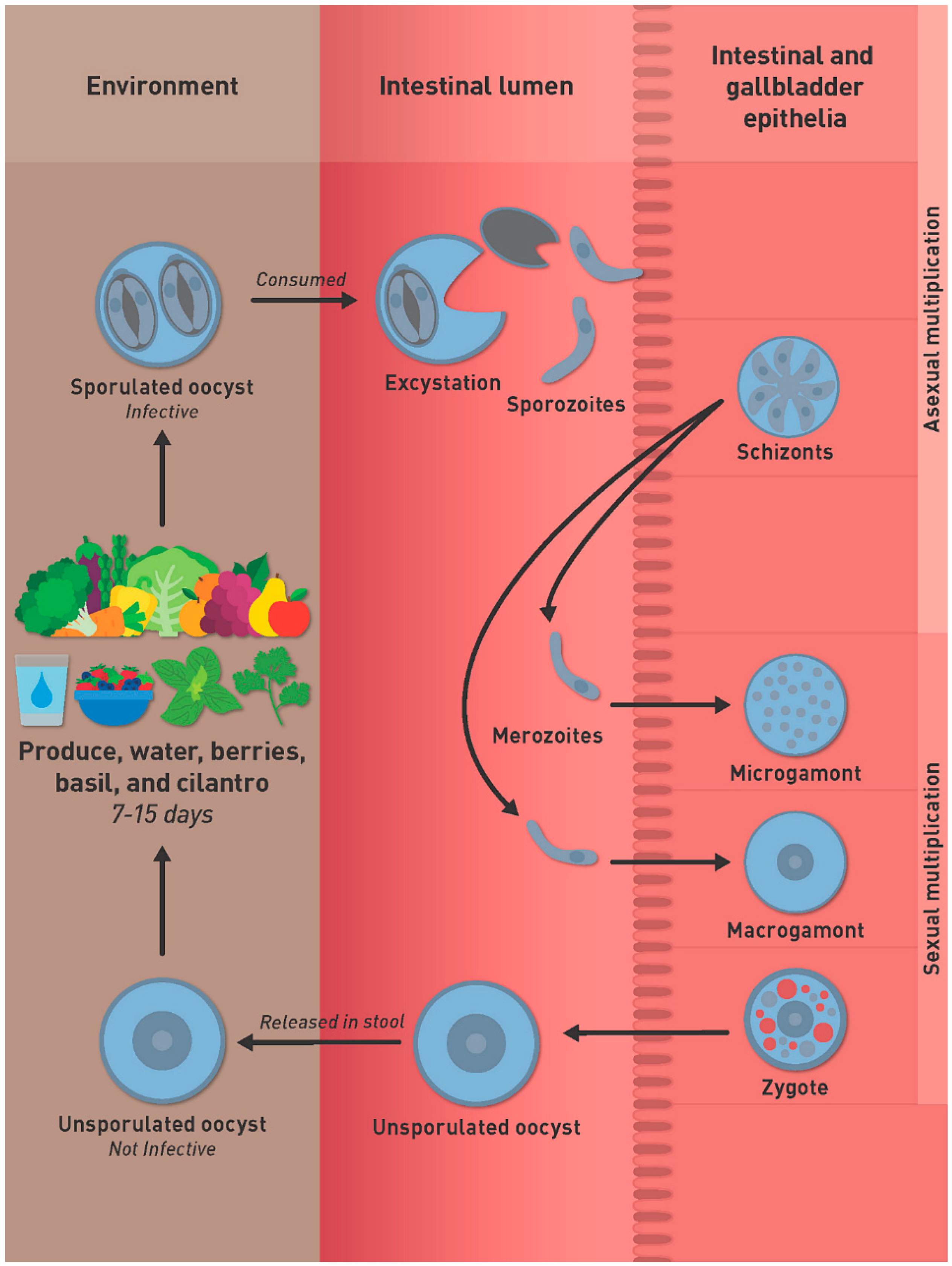
As far as is known, the parasite is shed in the stool of its host in the form of an oocyst. Animal hosts include livestock and poultry, and traces of fecal matter may end up contaminating water and food crops in agricultural settings.
These oocysts aren’t infectious yet – they have to go through a process called sporulation, which takes 1-2 weeks.
If the sporulated oocysts are consumed by a human, the parasite can then continue its life cycle inside the intestines. Hence, all the diarrhea.
Thoroughly wash and cook food, say authorities
With no source yet identified, authorities are recommending general food safety steps that could help limit the risk of catching the parasite.
“Heating food to 158°F (70°C) or higher kills Cyclospora,” the MDHHS update continues. Wherever possible, they recommend that all produce be thoroughly cooked to these temperatures; if not, all produce should be thoroughly washed, even if it will then be peeled.
MDHHS notes that people at higher risk of complications from dehydration or those with weakened immune systems are most at risk of serious illness. Anyone who suspects they may have cyclosporiasis is advised to contact their local health department.
While no particular food or supplier has been implicated in the current outbreak, foods that have previously been linked with Cyclospora in the US include:
- Bagged salads
- Cilantro (coriander) leaves
- Basil
- Raspberries
- Snow peas (mangetout)
- Green onions (scallions)
Symptoms can last up to 1 month
It’s not only Michigan that has seen a rise in cyclosporiasis reports recently.
According to USA TODAY, New York City is currently coming in second with 301 recorded cases up to July 7. Some of those include people who acquired their infection during overseas travel. Ohio, North Carolina, and Illinois have also reported more cases than are typical.
These clusters of cases are not likely to be linked with each other. While the illness can be very unpleasant, one point of difference versus something like norovirus is that it does not spread easily between people.
Where people in the same household do get infected, it’s usually because they have all consumed the same contaminated food or water.
The symptoms mimic those of other gastrointestinal illnesses and typically occur about one week after exposure.
They most commonly include:
- Watery diarrhea
- Loss of appetite
- Stomach cramps
- Bloating
- Gas
- Nausea
Other symptoms like vomiting, headache, and low-grade fever may occur, but are less common.
While many stomach bugs clear up quickly, this one can hang around for up to a month. The Centers for Disease Control and Prevention explains that the diarrhea may go away and come back, and symptoms like fatigue can also linger after the acute illness has cleared up.
Most people will fully recover, but it’s important we don’t dismiss infections like this or forget that they represent a major global health concern. As a 2020 paper notes, diarrheal disease is still a leading cause of mortality around the world, causing more than 1.6 million deaths in 2016.
Surveillance will continue to monitor whether these case clusters continue to grow, and whether any specific cause can be found.
The content of this article is not intended to be a substitute for professional medical advice, diagnosis, or treatment. Always seek the advice of qualified health providers with questions you may have regarding medical conditions.



 2
2