Space and Physics
 PUBLISHED


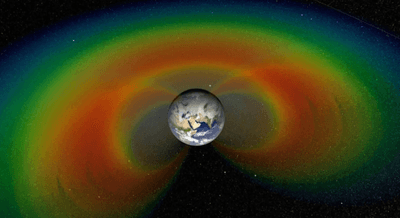


Along with summoning beautiful aurora in the night sky around the world, the gusty solar storm that rocked Earth in May this year left another legacy: a new Van Allen Belt looping around the planet.
The Van Allen belts are two donut-shaped belts of radiation wrapped around Earth, composed of energetic charged particles trapped in the planet's magnetic field. According to NASA, a temporary third belt has recently emerged around Earth as a result of the intense solar storms in May.
“Scientists are studying the data to better understand the Belt and how long it might stick around. Stay tuned for their findings!” NASA posted on X, formerly Twitter.
Most of the energized particles caught in the belts are believed to come from the solar wind, while others arrive as cosmic rays. When strong solar storms hit Earth, just like they did in May, it can cause a disruption that allows a third layer of charged particles to become ensnared by the magnetosphere.
The new belt was found sandwiched between the two permanent ones by NASA’s Colorado Inner Radiation Belt Experiment (CIRBE) CubeSat, a satellite that keeps an eye on Earth's inner radiation belt. While it’s unclear how long it might linger, the space agency said it could “last months to years.”
It’s well-established that solar storms, an intense flurry of emission of high-energy particles from the Sun's atmosphere, can meddle with Earth’s Van Allen belts. In September 2012, there was another instance of strong solar weather creating a third temporary Belt, which faded away in a matter of weeks.
Explaining the 2012 event, Ian Mann, a physics professor at the University of Alberta, said in a statement: "Rather like a space tsunami, they slosh the radiation belts around and very rapidly wash away the outer part of the belt, explaining the structure of the enigmatic third radiation belt."
The geomagnetic storm of May 2024 was the strongest that has been detected for 20 years. Along with the formation of a third Van Allen belt and the creation of a previously unseen vortex in Earth's atmosphere, the most noticeable impact on Earthlings was the sight of stunning Northern Lights in latitudes that aren’t usually blessed with auroras.
Don’t be fooled, though, geomagnetic storms have the potential to cause much more upset than pretty colors in the night sky. Much of the technology that runs the world, such as GPS and satellite-based telecommunications, can be affected by aggressive space weather. If a strong enough solar storm were to strike Earth today – just as it did in 1859 – it could prove catastrophic.