Nature
 PUBLISHED
 6
6

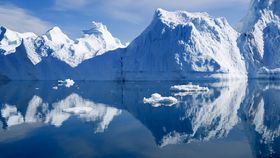


So far, this year: satellite images have shown ice melt in Antarctica has sextupled since 1979; Greenland lost a jaw-dropping 217 billion tons of ice in a single month; record temperatures were reported in the Arctic Circle, and Iceland lost its first glacier to climate change.
Also in the news is the grim fact that melting glaciers are now exposing dead bodies, nuclear fallout, and land that has not been seen for more than 40,000 years.
It is perhaps no wonder that some people are proposing a human intervention to stop – or reverse – this ice melt. One team doing just that is a group of Indonesian designers led by architect Faris Rajak Kotahatuhaha, whose ambitious proposal involving submarines and artificial hexagonal icebergs came second in the most recent ASA International Design Competition.
The competition required entrants to submit “fresh ideas in sustainability”, calling for "approaches so radical, unanticipated, and transformative they earn the epithet ‘uncanny’". Kotahatuhaha and co's idea requires submarines, whose central cavities fill with seawater as they submerge below the surface. The salt is extracted via a filter so that the water's freezing point is elevated.
The hatch is then closed and the water is given time to freeze naturally. One month later, the resulting (hexagonal-shaped) iceberg expelled. Why a hexagon? The idea is that it would make it easier for the individual icebergs to join up and form – honeycomb-like – large structures.
Other bold schemes put forward over the years include a plan to erect 10 million wind-powered pumps to push cold water to the surface during wintertime and another that would use snow machines to coat the Alps in artificial snow. Scientists have also suggested building artificial islands and giant underground walls to block warm water.
As for the proposal to use subs and hexagon icebergs, it is far from being a feasible option in reality and is very much an early concept. For starters, you would need some 10 million subs to offset polar ice lost over the last 40 years, Andrew Shepherd, professor of Earth observation at the UK's Leeds University, told CNN.
"It’s like trying to save the sandcastle you built at the beach using a dixie cup as the tide comes in," Michael Mann, professor of atmospheric sciences at Penn State, told NBC.
Another problem: you would have to find a way to move the icebergs to land if you want to make any sort of difference to sea levels. If the bergs just continue to bob on the water, the mass of the sea doesn't change – and neither do sea levels.
Finally, it doesn't actually address the cause of the ice melt – which is human-driven climate change triggered by greenhouse gas emissions. As with many forms of geoengineering, it is a temporary fix but not necessarily a solution to the problem.
Geoengineering – aka "the deliberate large-scale intervention in the Earth’s natural systems to counteract climate change", as per the Oxford Geoengineering homepage – is a controversial subject. Some argue it may become the only way to prevent a climate catastrophe. Others say it is not just unrealistic but could unleash a whole load of new problems and distract from the urgent need to cut carbon emissions.
Projects like these might seem unfeasible right now but who knows what might be possible in the future – as Shepherd says, it's an "interesting engineering solution".