Humans
 PUBLISHED
 1
1


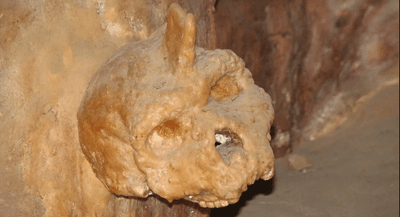


The Petralona skull is a real head scratcher. Found embedded in a cave wall, the prehistoric specimen appears to be neither Homo sapiens nor Neanderthal, yet it has continually resisted most attempts to fit it neatly into the existing human family tree.
The remains were first discovered by archaeologists in the 1960s within a limestone cave near Thessaloniki in northern Greece.
Over millennia, mineral-rich water dripped steadily over the skull, encrusting it in deep brown calcite. Eventually, the bone essentially fused with the surrounding rock, creating the haunting impression of a trapped soul lurching out of the cave wall. Its lower jaw was never recovered, most likely because it had been swallowed by the calcification process.
At first glance, the prehistoric skull was believed to belong to a member of the Homo erectus or Neanderthal lineages. Some later work even hinted it might be an early representative of Homo sapiens, which would be a bombshell discovery given its location and potential age. However, further research revealed it lacked many of the features you’d expect to see in these well-known characters.
Interestingly, the Petralona skull bears a striking resemblance to a 300,000-year-old cranium found in Zambia, southern Africa, over a century ago. Most researchers classify this specimen as Homo heidelbergensis, an extinct hominin that is thought to be a common ancestor of both Neanderthals and modern humans.
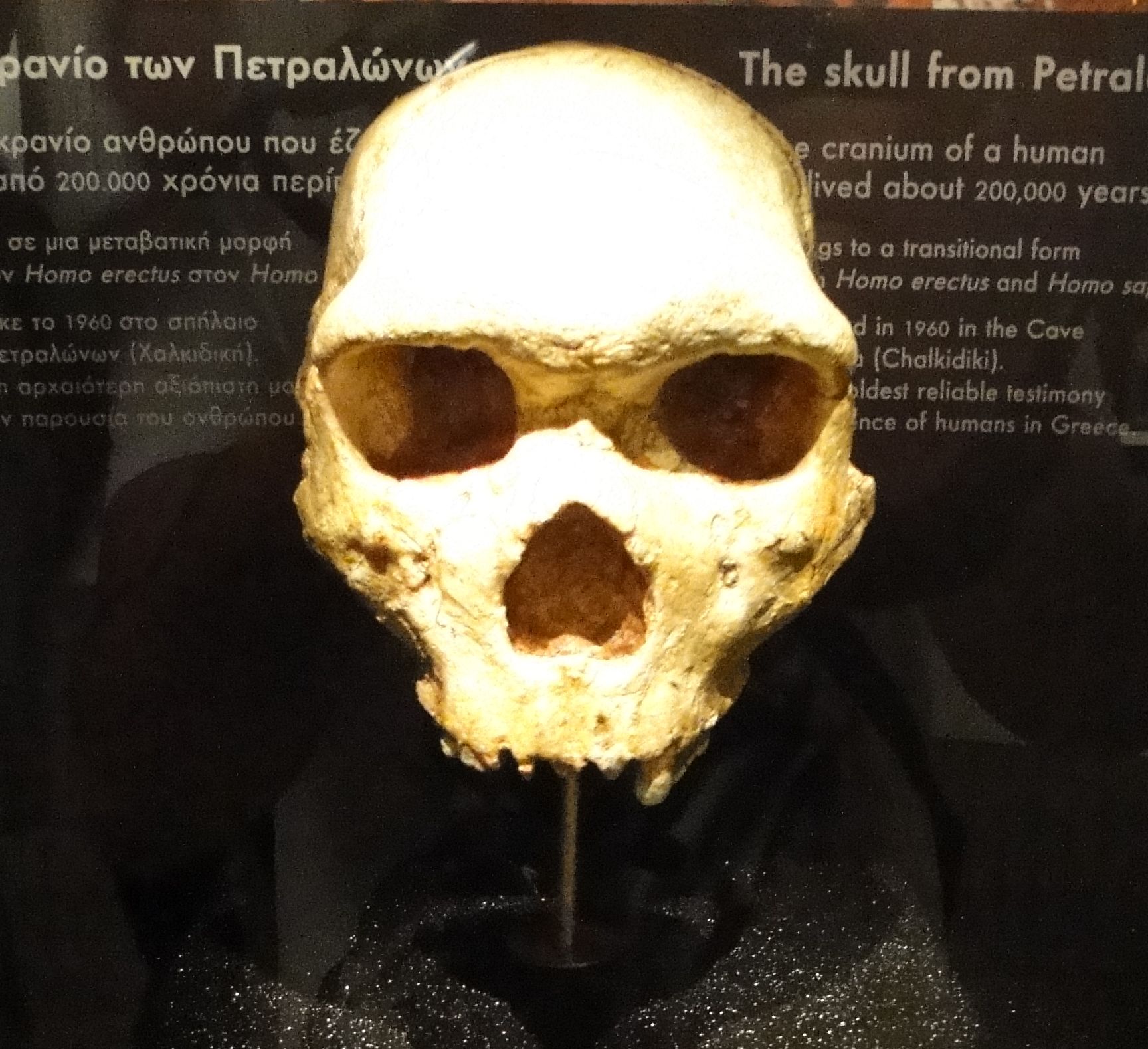
Another major hurdle in identifying the "Petralona Man" is its inconsistent timeline. Because the skull was found encased in layers of minerals rather than clear sedimentary strata, dating it has proven notoriously difficult. Various studies have returned ages ranging from 170,000 to 700,000 years, a wide window that still leaves many options on the table.
In 2025, researchers made a significant breakthrough when they used uranium-series dating on the calcite that grew on top of the cranium. This gave the minimum age of around 286,000 years, give or take 9,000 years, suggesting it may be contemporary with the H. heidelbergensis cranium from southern Africa.
“Morphologically, they belong together and dating-wise they seem to be close too,” Professor Chris Stringer, a leading palaeoanthropologist at the Natural History Museum in London and one of the 2025 study’s co-authors, told BBC Science Focus.
“If the calcite on the fossil developed very quickly after the fossil was deposited in the cave, then our age of about 288,000 to 290,000 is a good age for the fossil. But if the fossil actually had lain around in the cave before the calcite got on it, then that age is only a minimum age,” he added.
This robust date bolsters support for the idea that European and African populations of this prehistoric human species may have remained closely related throughout the Middle Pleistocene, forming one expanded lineage known as H. heidelbergensis sensu lato that lived across a huge region of the planet. However, as is typical with the study of human evolution, the reality is likely even more complex than this already muddled story suggests.