


 Humans
 PUBLISHED






A scorched papyrus scroll that's remained unopened since the eruption of Mount Vesuvius in 79 CE has… still not been opened.
However, by using high-resolution X-rays and machine learning researchers have been able to digitally unwrap the ancient document and read the entire surviving portion of text while leaving it entirely intact.
The scroll, known as PHerc. 1667, is the first from the library of Herculaneum to be read from start to finish, with the text spanning 22 columns of ancient Greek.
The library, containing at least 1,800 scrolls, was found in the remains of a building called the Villa of the Papyri in the mid-eighteenth century. It became encased in ash and volcanic debris during the catastrophe that destroyed Pompeii and Herculaneum, making the building the only surviving large-scale library from classical antiquity.
But despite the remarkable state of preservation, the scrolls are extremely fragile, and all attempts to physically open them have resulted in their destruction. Back in the nineteenth century, researchers caused part of PHerc. 1667 to disintegrate when they tried to unwrap it, while similarly clumsy attempts in 1969 and the 1980s saw further portions of the document lost.
Rather than repeating the same mistakes on the surviving section of the scroll, researchers have been using digital scanning techniques and artificial intelligence to try and read PHerc. 1667. Over the past few years, scientists have made remarkable breakthroughs using this technique, finally managing to decipher the first written word on a separate scroll back in 2023.
But now the team have taken a huge leap forward.
They have been able to read continuous sentences and columns of the scroll. While the title and name of the author have both unfortunately been lost during the earlier attempts, from what remains researchers were able to deduce that the scroll contains a discussion of Stoic philosophy.
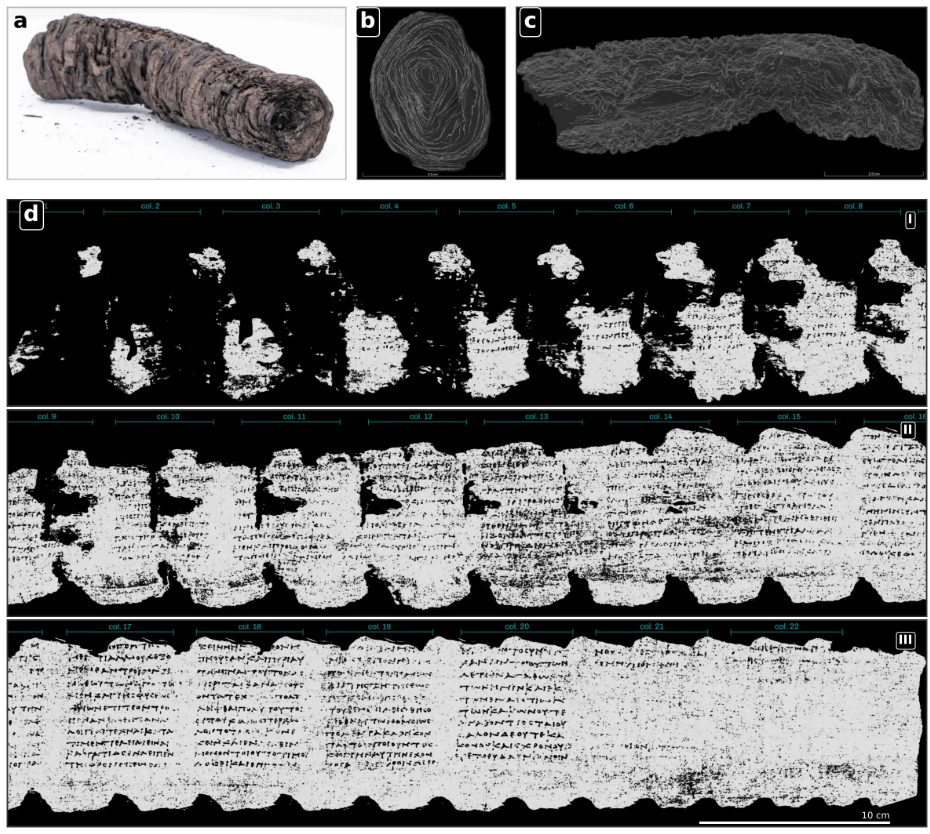
Delving into subjects like human nature, the virtue of reason over impulse, and the moral development of human beings, the text culminates by name-dropping Aristocreon, whose uncle was the celebrated Stoic philosopher Chrysippus.
Among the phrases highlighted by the researchers was: “we will inquire into something, but we will not grasp it, if in some way we depart from ourselves and from our own nature.”
In this case, though, it seems there are certain things that we can grasp as a result of this staggering breakthrough. For instance, based on the scroll’s contents and the style in which it is written, experts believe it was penned in the second century BCE.
Presenting their work in a new study, which has yet to undergo peer-review, the authors state that it’s unclear if their technique will work on all of the Herculaneum scrolls.
Regardless, the fact that it worked so well for PHerc. 1667 – which was burnt to a crisp 2,000 years ago – is enough to make even the most stoic among us crack a smile.



 8
8