Space and Physics
 PUBLISHED



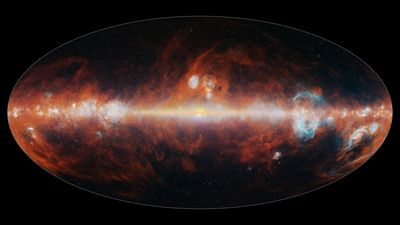


NASA has just released two images from its recent near-infrared SPHEREx mission. This is an incredible near-infrared space telescope that aims to collect the detailed light spectrum of 450 million galaxies. To do that, it has very narrow filters which are equivalent to how we categorize colors, only not in the light that we can see.
Colors are a complicated beast. For example, not every culture has a word for blue, and we know naming shades of a particular hue allows people to see them more distinctly. Your blues and your greens might not even be my blues and greens. Scientifically, we are looking at the wavelengths of light, which exclude some colors we know, such as magenta, which are not made by a single wavelength.
We can take colors across any part of the electromagnetic spectrum and turn them into beautiful images, too. One just has to assign colors that we see to the wavelength range picked up by telescopes. Some telescopes have a few broad filters, so a handful of colors are selected. Others have many narrow filters. SPHEREx has an incredible 102, demonstrated in its first utterly stunning infrared all-sky map.
“It’s incredible how much information SPHEREx has collected in just six months — information that will be especially valuable when used alongside our other missions’ data to better understand our universe,” Shawn Domagal-Goldman, director of the Astrophysics Division at NASA Headquarters in Washington, said in a statement.
“We essentially have 102 new maps of the entire sky, each one in a different wavelength and containing unique information about the objects it sees. I think every astronomer is going to find something of value here, as NASA’s missions enable the world to answer fundamental questions about how the universe got its start, and how it changed to eventually create a home for us in it.”
SPHEREx goes around the Earth 14.5 times a day. It takes about 3,600 images along one circular strip of the sky, with every circle. As the Earth moves around the Sun, it drags the telescope along, giving a slightly different view of the sky every day. It takes the telescope about six months to snap the entire sky once.
“The superpower of SPHEREx is that it captures the whole sky in 102 colors about every six months. That’s an amazing amount of information to gather in a short amount of time,” explained Beth Fabinsky, the SPHEREx project manager at NASA’s Jet Propulsion Laboratory (JPL). “I think this makes us the mantis shrimp of telescopes, because we have an amazing multicolor visual detection system, and we can also see a very wide swath of our surroundings.”
The colors can also be used to measure the distances of hundreds of millions of galaxies, producing an extraordinary three-dimensional map of the universe. Armed with that, scientists will be able to better understand the properties of the cosmos at large, including mysteries such as cosmic inflation, dark energy, and more.
“SPHEREx is a mid-sized astrophysics mission delivering big science,” said JPL Director Dave Gallagher. “It’s a phenomenal example of how we turn bold ideas into reality, and in doing so, unlock enormous potential for discovery.”
The whole dataset is freely available to scientists and the public to use.