Humans
 PUBLISHED
 1
1



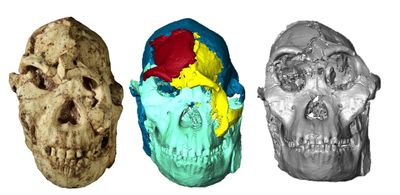


Researchers have reconstructed the face of a prehistoric hominin named Little Foot, which roamed southern Africa some 3.67 million years ago and predates the appearance of the Homo lineage by about a million years. It appears to have had a face resembling that of chimpanzees and orangutans
Little Foot is the most complete early hominin skeleton ever discovered. Due to its incredible age, the fossil is unsurprisingly compressed and weathered, leaving the skull somewhat misshapen. As a consequence, researchers had until now been unable to reconstruct its face.
To overcome this difficulty, the authors of a new study used synchrotron scanning and advanced virtual reconstruction techniques to create a digital model of Little Foot’s face. The features revealed by this provide fascinating insights into the evolution of human facial morphology.
For instance, the overall shape and size of Little Foot’s face was found to fall within the same parameters as two specimens from Ethiopia, named Australopithecus afarensis and Australopithecus anamensis, which date to 3.8 million years ago. Surprisingly, however, Little Foot shared fewer similarities with the southern African Australopithecus africanus, which lived about 300,000 years later.
Put another way, Little Foot had more in common with its relatives from thousands of miles away than it did with its own descendants in its homeland.
“This pattern is unexpected, given the geographic origin of Little Foot and suggests a more dynamic evolutionary history than previously assumed,” said study author Amélie Beaudet in a statement. For instance, the researchers suggest that while Little Foot and its contemporaneous Australopithecines in East Africa might have shared a “generalized” facial anatomy, later specimens living in southern Africa seem to have undergone selective pressures that altered the shape of their face.
More specifically, these pressures appear to have influenced the morphology of the eye sockets. According to the reconstruction, Little Foot’s orbits resembled those of chimps and orangutans, while those of the younger southern African fossils did not.
The forces that shaped this change are still unclear, although the researchers speculate that fluctuations in the climate and ecology of southern Africa might have driven a need for sharper eyesight when hunting and gathering. “Evolutionary pressure might have acted specifically on the orbital region in southern African Pliocene hominins, perhaps in conjunction with environmental instability leading to food resources becoming scarce and more difficult to spot or fallback foods requiring specific visual capacities,” they write.
In contrast, East African Australopithecines may have experienced more constant conditions, resulting in less need for these facial adaptations.
Overall, these findings point towards a patchwork of human evolutionary traits across Africa in the period before the Homo genus first appeared. “Rather than viewing early hominin evolution as occurring in isolated regions, the study supports the idea of Africa as a connected evolutionary landscape, with populations adapting to ecological pressures while remaining linked through shared ancestry,” says study author Dominic Stratford.
The study has been published in the journal Comptes Rendus Palevol.