Nature
 PUBLISHED
 1
1


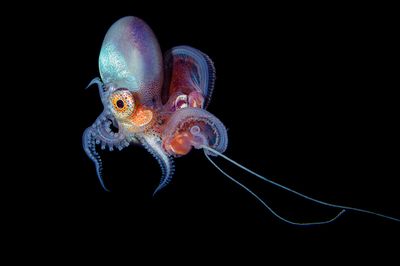


If they didn’t already exist, octopuses might make great sci-fi creatures. They are super-smart, sometimes venomous, and let’s be honest, just the number of tentacles alone is a Doctor Who villain-level of freaky.
When it comes to more scientific explanations, why are octopuses so out-of-this-world? One reason is that they are master editors – not the kind one might find at IFLScience (although it would make an interesting addition to the office), but of their own RNA.
RNA is a key molecule in the production of proteins; the central dogma of molecular biology is that DNA holds the instructions, which are copied into messenger RNA (mRNA). Ribosomes, aka the cellular protein factories, read the mRNA and translate the code into a chain of amino acids, which becomes a protein.
Following this principle, the only way that proteins could change is by DNA mutation, which can take a long time and thus isn’t ideal if you need to quickly adapt to your surroundings. Octopuses, like other cephalopods, can temporarily put biological doctrines aside and edit their RNA.
Humans are also capable of editing their RNA, but it is rare for this to lead to changes in the amino acid structure of proteins. In comparison, cephalopods like the longfin squid successfully recode protein structures through RNA editing in the majority.
Researchers think this is how octopuses are so adaptable to their surroundings.
“Instead of a DNA sequence producing only one protein, with the ability to recode by editing the RNA, this sequence can generate several proteins with different functions, increasing the animal's ability to adapt to different situations,” octopus researchers Michaella Pereira Andrade and Tatiana Leite told IFLScience.
Providing evidence for this theory, a study earlier this year revealed that the California two-spot octopus uses RNA editing to adapt to temperature changes.
Over the course of several weeks, acclimated wild-caught octopuses to either warm or cold waters. They then compared the octopuses’ RNA transcripts to the original DNA, to see if any RNA editing had occurred at previously established editing sites and found a significant number of changes.
“Temperature-sensitive editing occurred at about one third of our sites—over 20,000 individual places—so this is not something that happens here or there; this is a global phenomenon,” said co-senior author Eli Eisenberg in a statement.
The researchers also found that editing occurred at greater levels in the cold and that the edited proteins tended to be neural proteins, suggesting that one of the reasons why octopuses change up their RNA is to maintain neurological activity when their surroundings get chilly.
Although octopuses remain strictly Earth-dwelling, their adaptable brains could also provide clues to what extra-terrestrial intelligence might look like. To find out more, check out Issue 8 of CURIOUS, where IFLScience interviewed researchers investigating octopus sentience.