Space and Physics
 PUBLISHED

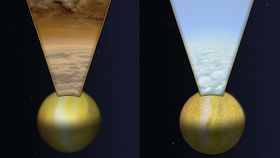


Scientists have studied two worlds that, at first glance, look almost exactly the same. On closer inspection, however, there are some key differences that could upend our theories of planet evolution.
The two planets are hot Jupiters, gas giant planets that orbit incredibly close to their host star. These are thought to form in a more distant orbit, before migrating inwards.
WASP-67 b (0.42 times the mass of Jupiter) and HAT-P-38 b (0.27 Jupiter masses) are essentially cousins, both being hot Jupiters of a similar size and temperature, about 700°C (1,300°F). They also both orbit yellow dwarf stars in about 4.5 days, which is much closer than Mercury orbits our Sun (88 days).
But by using the Hubble Space Telescope, researchers found that WASP-67 b has much thicker clouds than HAT-P-38 b, and it’s not clear why. The findings were presented yesterday at the 230th meeting of the American Astronomical Society in Austin, Texas.
“Right now, they appear to have the same physical properties,” lead researcher Giovanni Bruno of the Space Telescope Science Institute in Baltimore, Maryland, said in a statement. “So, if their measured composition is defined by their current state, then it should be the same for both planets. But that's not the case.”
Hubble's Wide Field Camera 3 was used to study the starlight passing through each planet’s atmosphere. The clearer a planet is, the more water is likely to be in the atmosphere. Without water, the thicker and higher the clouds are.
The clouds are unlikely to be like ours on Earth, though. They are probably more likely to be alkali clouds, made of molecules such as sodium sulphide and potassium chloride.

Each planet is also tidally locked to their star as they orbit so close, which means one side is very hot in constant daytime and the other is much cooler in constant night. A broad equatorial band of clouds may transfer heat from one side to the other.
As to why these planets are different, it may have something to do with their formation. Getting to the bottom of this will tell us more about how planets evolve in other systems.
“[T]here had to be something in their past that is changing the way these planets look," said Bruno.
Since we first started finding exoplanets in 1992, hot Jupiters have been found to be pretty common. They’re easier to find than Earth-like worlds, as they are so big and orbit so close, which means we can see them transit more frequently.
That our Solar System has no hot Jupiters is another mystery. Perhaps learning more about how these planets get so close to their star will get us closer to the answers we’re after.