Culture and Society
 PUBLISHED
 5
5


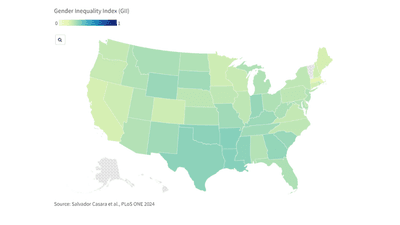


An international group of researchers has developed a new tool for measuring gender inequality between women and men in the United States, and in doing so, revealed which states have the greatest levels of inequality for women.
According to the team’s findings, gender inequality is at its highest in Arkansas, closely followed by Louisiana and Oklahoma. The state with the lowest gender inequality, on the other hand, was found to be Massachusetts, with California and Maine coming in with the next lowest levels.
The purpose of the study was to validate the researcher’s newly developed tool for measuring gender inequality. One of the main measures used is the Gender Inequality Index (GII), which gives an indication of gender inequality at the country level – that comes in handy when you want to see how countries differ.
However, the GII isn’t considered suitable for measuring gender inequality within a country.
“Although country-level comparisons are relevant for providing a broader perspective on social phenomena across a range of cultures and contexts, they often face challenges due to varying data collection methods and cultural differences, introducing methodological inconsistencies (e.g., 'qualitative' ideological differences) and making strict quantitative analysis difficult,” the researchers write.
In comes the GII-S, designed by the team to measure gender inequality at the state level and the US, the team posits in their study, makes a great place to test the new tool.
“The United States offers a unique setting for comparing gender inequality within a country. Despite shared cultural elements and uniform data collection by federal agencies, US states exhibit significant diversity in demographics, laws, and attitudes on issues linked to gender inequality themes.”
Two experiments were carried out within the study, although Alaska, Hawai’i, and Vermont had to be excluded due to a lack of relevant data. Not only did the tests suggest the GII-S was a valid tool, but also allowed the researchers to identify some of the factors that could be associated with gender inequality in the US.
For example, the first uncovered a correlation between gender inequality and measures of life satisfaction and perceived safety, such that higher inequality was associated with lower life satisfaction and feelings of being safe for women. It also found a negative association between GII-S and health and financial wellbeing for both men and women.
The second study looked at how GII-S might be associated with political orientation, but also taking part in collective gender equality action like the #MeToo movement, using data from social media platform X, formerly known as Twitter.
“Analysis of geo-localized messages on the Twitter social media platform reveals that higher GII-S scores were associated with fewer tweets containing the #MeToo hashtag. Moreover, GII-S was associated with state-level political orientation: the more conservative a state, the higher its level of gender inequality,” the authors write.
Though the researchers didn’t go so far as to say there was a causal relationship between GII-S and the factors they identified, they suggest it’s a reliable tool and the associations identified can not only give those with the means to address gender inequality a starting point for how they might do so, but also help in spreading awareness and support.
“The awareness of the negative correlates of gender inequality for everybody can be an important element in gathering support from a larger part of the population,” they write, highlighting the effects on both men and women, and “by confirming the reliability of the GII-S, policymakers and advocates can use an effective tool to examine and tackle gender disparities in specific areas of the country.”
The study is published in the journal PLoS One.