Health and Medicine
 PUBLISHED
 2
2


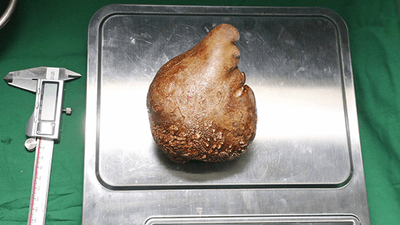


A man has broken one of the world records you don't want to set, after having a 13.372-centimeter (5.264-inch) kidney stone removed.
Army doctors removed the kidney stone – the largest on record – from Canistus Coonghe at the Colombo Army Hospital in Narahenpita, Sri Lanka on June 1. The stone weighs in at 801 grams (1.76 pounds), or roughly the weight of a 6-9-week-old kitten, though admittedly less adorable. The previous record, as documented by the Guiness Book of World Records, was set in 2004 at 13 cm (5.11 in) and weighed 620 grams (1.37 pounds).
Following the record-breaking surgery, the stone was shown to the Commander of the Army, Lieutenant General Vikum Liyanage, in the same way an athlete might meet the President after getting gold in the Olympics.

Kidney stones are solid, stone-like objects made of a buildup of chemicals in the kidneys, as they filter them out of your blood. They can be formed of calcium oxalate, uric acid, struvite, and cystine, and more commonly develop in people who suffer from kidney or urinary infections.
Symptoms of the stones include sharp pains in your back, groin, sides and lower abdomen, as well as blood in the urine. More serious problems can occur if the kidney stone blocks the flow of urine from the kidneys, and cause patients severe pain in the abdomen and groin.
Smaller stones can be passed without you even noticing, while larger stones – for instance, the world's largest stone – require surgery. According to one study, though, there is a much more fun way to dislodge kidney stones: riding on rollercoasters. The study created a 3D model of a kidney and placed real kidney stones inside, before taking it for a ride on Big Thunder Mountain 20 times. Stones placed in the upper passage were dislodged in all 20 rides, while those placed in the lower passages were more difficult to shift.