


 Culture and Society
 PUBLISHED


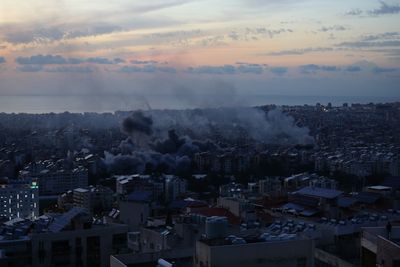


The World Health Organization (WHO) is closely watching the US-Israel war with Iran and remains “vigilant” for any type of nuclear threat, said Hanan Balkhy, WHO regional director for the eastern Mediterranean.
“The worst-case scenario is a nuclear incident, and that's something that worries us the most,” Balkhy told POLITICO. “As much as we prepare, there's nothing that can prevent the harm that will come… the region's way – and globally if this eventually happens – and the consequences are going to last for decades.”
“We are thinking about it, and we're just really hoping that it does not happen,” she added.
The concern comes as the US and Israel launched surprise airstrikes on multiple sites and cities across Iran, killing Supreme Leader Ali Khamenei and numerous other Iranian top brass. In retaliation, Iran fired missiles and launched drone strikes against Israel, US military bases, and US-allied countries across the region.
Nuclear weapons are central to the conflict. One of the stated aims of the US-Israeli operation was to prevent Iran from obtaining a nuclear weapon. Meanwhile, the US and Israel are armed to the teeth. The US holds the world's second-largest nuclear arsenal, after Russia. Israel is also widely believed to possess a significant number of nuclear weapons, although the country maintains a policy of deliberate ambiguity, neither confirming nor denying the existence of a stockpile.
Some senior US officials have speculated about Israel's intentions if the war continues for months, with one White House advisor warning that “you have to worry about Israel escalating the war by contemplating using a nuclear weapon” – although President Trump has dismissed the concern, saying: “Israel wouldn't do that.”
Nevertheless, the potential use of nukes is just one part of the worry. Balkhy added that the WHO is assessing the possibility of a nuclear incident in its “broader sense,” such as a nuclear accident, radiation leaks, or the breakdown of nuclear safety infrastructure amid the conflict.
“I think those who read the history of previous incidents, whether intentional or accidental, are very aware of what we're talking about,” Balkhy said, referring to infamous nuclear catastrophes like Chernobyl and Fukushima.
As part of their offensive, the US and Israel have been targeting the sites where Iran enriches nuclear material. In early March 2026, the International Atomic Energy Agency (IAEA) confirmed that entrance buildings to the underground Natanz Fuel Enrichment Plant had sustained fresh damage from the ongoing attacks.
While the agency said no radiological releases were seen in the latest strikes, IAEA Director General Rafael Grossi has been unambiguous about the broader risk. He reportedly warned that armed attacks on nuclear facilities should be avoided at all costs, as they will lead to radioactive releases with serious consequences beyond national borders.
Civilian nuclear sites are also dotted around this part of West Asia, which has been attacked by Iran and its proxies. The UAE is home to four nuclear reactors, Jordan and Syria maintain research reactors, and numerous other states in the region rely on nuclear technology for medical, industrial, and scientific purposes – all of which are potentially vulnerable in a conflict of this scale.




 1
1