Culture and Society
 PUBLISHED




What’s the most quintessentially American pastime? Baseball? Football? Competitive hotdog eating? No? How about serial murder?
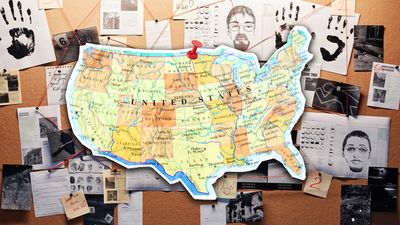
It’s not a dig. The US leads the world in number of known serial killers, and it’s not even close: out of 5,757 cases worldwide, an astonishing 3,803 came from the “land of the free”. That’s almost two out of every three serial killers – twice as many as the entire rest of the world combined.
So, uh. What the hell is going on?
Slipping foundations
To make a serial killer, quite a few things need to go wrong. It just so happens that, for decades now, the US – its geography, its home and foreign policy, even the foundational myths baked into the very psyches of its citizens – has made it very easy for that to happen.
“Imagine this: you're in California; a body is found,” said Simon Ford, a journalist, consultant, and lecturer, in a September 2025 two-part episode of his Psycho Killer podcast. “The county sheriff investigates, but they don't share findings with the next county. Over the next day, another body, another jurisdiction, another set of detectives, another set of procedures.”
It may sound like too obvious a crack to go unnoticed – but it’s precisely what happened in the case of Joseph James DeAngelo, better known as the Golden State Killer. For almost a decade, he terrorized California, raping more than 50 women and girls, murdering at least 12, and committing hundreds of burglaries – all the while upholding a perfectly normal-seeming life in Sacramento.
“He evaded capture for decades, not because he was a mastermind, but because law enforcement agencies weren't talking to each other,” explained Jaques Morrell, a former major crimeand homicide detective in the UK, in the same episode. “It wasn't until DNA evidence and a public genealogical database connected the dots in 2018 that he was unmasked, at the age of 72.”
It’s a striking example of an ever-present problem for American detectives nationwide: in a country so vast, with such easy freedom of movement between jurisdictions, and a network of law enforcement agencies that are often disjointed, sometimes overlapping, and occasionally at odds with each other, it’s just too easy for killers to slip into the shadows.
“Compare that to the UK, where a single body like the National Crime Agency can operate across the country, or Canada's RCMP [Royal Canadian Mounted Police],” pointed out Ford. “In the US, you've got sheriff's departments, city police, state bureaus, federal agencies all working side by side – just not always together.”
But it wasn’t only California’s size and bureaucracy that allowed DeAngelo to operate with impunity for so long. Key to his success was another hallmark of American life: the suburbs.
“If you want to understand what some have called, without a hint of irony, the ‘Golden Age of American serial killers’, you need to understand suburbia,” said Morrell. “The physical separation between homes, the lack of community scrutiny, and the anonymity offered by suburban sprawl – all of it enabled serial killers to operate unseen even by their own families.”
“These killers weren't just invisible, they were camouflaged,” agreed Ford. “The suburbs taught people to mind their own business, to stay behind closed doors, and that culture of isolation gave monsters room to breathe.”
Brewing trouble
It may seem grim to refer to a “golden age” of serial killers, but the term is justified. Out of all known serial killers in the US, it’s estimated that some 80 percent were active between 1970 and 1999 – a figure that has prompted speculation from experts and amateurs alike as to a potential cause.
And as it turns out, there are quite a few to choose from. Some people attribute it to the lead-crime hypothesis: the idea that basically everybody before 1990 or so was being exposed to dangerous levels of lead – mostly from gasoline, though some from paint and other sources – which made them predisposed to committing more violent crime.
Some blame the Vietnam war, a conflict that saw millions of American men drafted out of their normal lives and into sometimes unimaginable horror – a world in which they saw, and committed, some of the most terrible crimes against humanity on record.
Then, they returned home, and were expected to just go back to an office or construction job, with little-to-no social safety net or even a diagnosis – post-traumatic stress disorder, or PTSD, was only added to the DSM-III in 1980, five years after the Vietnam war was over.
There’s some evidence to support this theory. It does seem true that post-war years see spikes in numbers of serial killers: “After World War One, we see early American serial killers like Earl Nelson emerge – the so called ‘guerrilla killer’,” noted Ford. “After World War II […] less of a spike, possibly due to the shorter war and tighter control of the media.”
But the post-Vietnam years saw not only a spike in numbers of serial killers, but also in the brutality of their methods, he explained. Perhaps the unique horrors of Vietnam, plus the relatively ignominious welcome soldiers received once back on home soil, was just enough to twist some psyches into a kind of killer not seen before.
The glamor of gore
The Vietnam war wasn’t the only societal change of the period. When it comes to understanding serial killers, and why so many come from the 1970s and 80s, there’s something very important that just can’t be overlooked: serial killers… weren’t really invented until 1981.
Now, obviously, people existed before that time who fitted the modern definition of “serial killer” – which, since 2005, has been “a person who murders two or more people in separate events”, even if most people usually use three victims as the baseline. But it wasn’t until 1981, and the case of Wayne Williams, that the term really entered the public lexicon – and once an exciting new phrase like that was loose, there was no stopping it.
“Although serial killing is statistically rare, it is nonetheless a ubiquitous cultural phenomena, one that for the vast majority of people is best understood as a media event,” wrote University of Alberta criminologists Kevin Haggerty and Ariane Ellerbrok in a 2011 piece for the UK’s Centre for Crime and Justice Studies.
“Serial killers have become an inescapable point of reference in movies, television fiction, novels, true crime books and video games.”
In short: serial killers have become celebrities – and they know it.
Some of the most notorious serial murderers enjoyed – even thrived on – the attention their crimes got them; the serial killer BTK, in 1978, even made the desire explicit, complaining in a letter to a Wichita television station about his perceived lack of recognition.
“How many do I have to kill,” he demanded, “before I get a name in the paper or some national attention?”
A deadly concoction
The USA, then, certainly has its issues. But are they really so great as to account for an almost 20-fold increase over any other nation in number of known serial killers? Surely, there’s some kind of counting error going on here, right?
Well, it’s certainly possible. The media may popularize, even glamorize, serial killers – but it’s also how we hear about them at all.
That’s true even for researchers: the database behind the headline figure was collated in the US, using sources including news articles, dissertations, and true crime books. That’s inevitably going to bias the results towards the most famous and highly publicized killers, most likely in the US, which were reported on in English.
But that, too, cannot explain the US’s freak number on its own. Rather, it’s a uniquely American collection of factors: fractured law enforcement, spread out across an entire continent; a cultural obsession with violence; extreme wealth and social inequality offering white men – the group that comprise 85 percent of serial killers – a ready pool of “disposable” victims; a lack of accessible social or health care, particularly for mental illnesses; perhaps even the country’s comparatively lax environmental laws might play a part.
And before you say it: we know, there’s something we haven’t mentioned yet.
By now, probably half of our readers are pulling their hair out wondering why we haven’t blamed the Second Amendment, and the other half are indignantly surprised for the same reason. But here’s the rub: serial killers don’t usually use firearms. It’s generally too impersonal for a killer motivated by psychological gratification.
Where guns are a problem, however, is mass shootings. And while the number of serial killers, even in the US, has been declining steadily since the 1990s, the figure for mass shootings has been heading steadily in the other direction.
“We might be seeing fewer traditional serial killers,” Ford said. “[But] violence hasn't vanished. It's just shifted form.”