Space and Physics
 PUBLISHED
 3
3



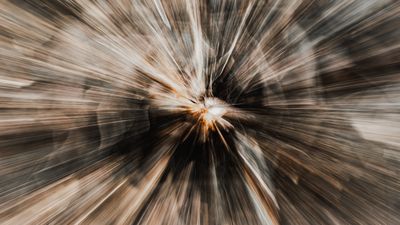


We know how the universe began. An event we call the Big Bang started it all about 13.8 billion years ago. How the universe ends, though, is an open question. The path forward depends on the properties of two hypothetical components of the universe: dark matter and dark energy, and one recent study suggests that the universe might collapse back on itself after 33.3 billion years.
This hypothesis is not new. It was given the affectionate nickname of Big Crunch, and says that the accelerated expansion of the universe is only a temporary condition. At some point, the expansion will slow down before reversing, with everything collapsing back into an impossibly dense state.
“For any life, you want to know how life begins and how life ends – the end points,” corresponding author Professor Henry Tye, from Cornell University, said in a statement. “For our universe, it’s also interesting to know, does it have a beginning? In the 1960s, we learned that it had a beginning. Then the next question is, ‘Does it have an end?’ For many years, many people thought it would just go on forever. It’s good to know that, if the data holds up, the universe will have an end.”
The Big Crunch had lost favor in recent decades with the discovery of the accelerated expansion of the universe. The simplest explanation for that is the presence of a cosmological constant, namely dark energy, present everywhere in the universe that pushes the universe apart. If it is constant, the universe will expand forever. Recently, though, data from the largest-ever map of galaxies and quasars suggested that it might be changing, getting weaker as the universe grows older.
This new work suggests that the nature of dark energy is mixed: part cosmological constant and part the energy of axions. Axions are a possible particle, much lighter than electrons, that would make up the equally mysterious dark matter. This peculiar mix leads to a point where gravity will bring everything in the universe back together again.
“People have said before that if the cosmological constant is negative, then the universe will collapse eventually. That’s not new,” Tye said. “However, here the model tells you when the universe collapses and how it collapses.”
There are other possible ways for the universe to end. Dark energy might be greater than the cosmological constant and rip space-time apart (Big Rip), the Big Bang and Big Crunch would be components of a never-ending repeating cycle (Big Bounce), and my personal favorite, the false vacuum decay, where a random quantum effect could bring back the end of everything without warning.
We will know more about the properties of dark energy from the Euclid observatory of the European Space Agency and the Vera C. Rubin Observatory.
A paper on this work is published in the Journal of Cosmology and Astroparticle Physics.