Space and Physics
 PUBLISHED
 19
19


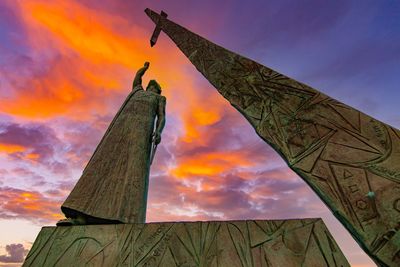


Pythagoras was undoubtedly a clever man, though his odd ideas about beans are still up for debate. What he’s best remembered for, however, is his mastery of triangles, a fact most of us were reminded of repeatedly in high school geometry through the Pythagorean theorem. But did the famed philosopher actually invent the formula that bears his name?
It turns out that the Babylonians got there before Pythagoras, and by quite a significant margin.
“Any history book will tell you that trigonometry goes back to ancient Greek astronomers,” ancient mathematics researcher Dr Daniel Mansfield told IFLScience back in 2021. “I like to think of the Babylonian understanding as an unexpected prequel.”
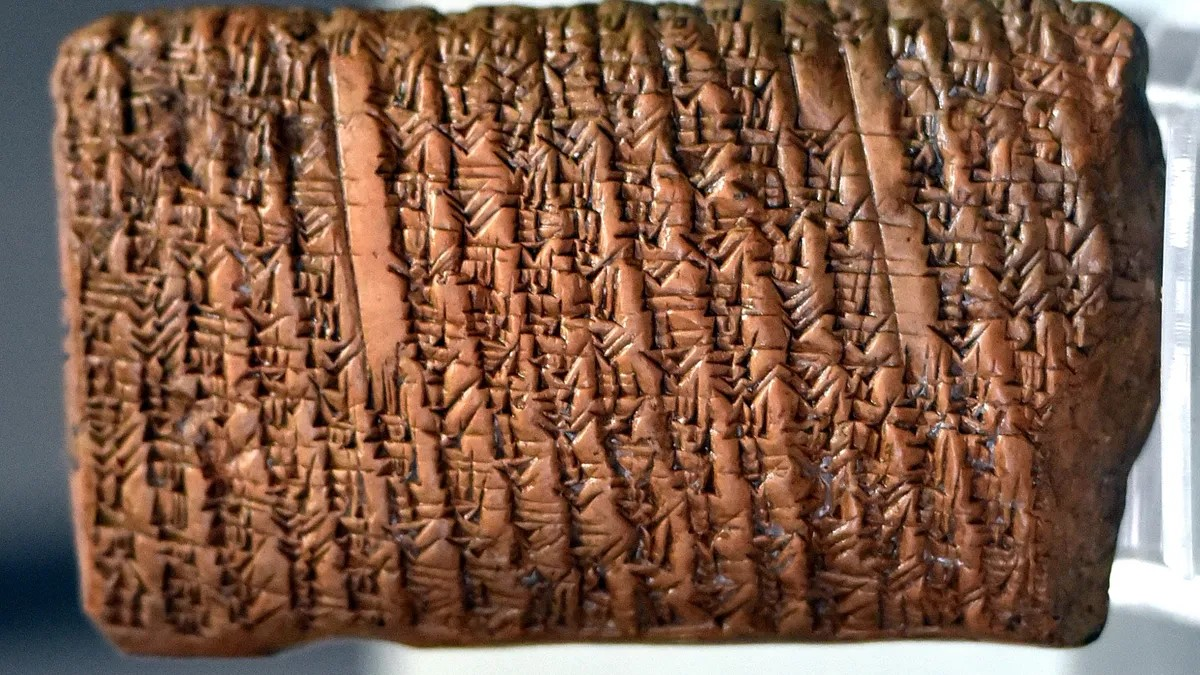
Some of the earliest evidence comes in the form of a clay tablet – which goes by the catchy name of IM 67118 – that uses the Pythagorean theorem to solve the length of a diagonal inside a rectangle. The tablet, likely used for teaching, dates to the Old Babylonian period between 1900-1600 BCE – centuries before Pythagoras was born in around 570 BCE.
Another tablet from around 1800-1600 BCE has a square with labeled triangles inside. Translating the markings from base 60 – the counting system used by ancient Babylonians – showed that these ancient mathematicians were aware of the Pythagorean theorem (not called that, of course) as well as other advanced mathematical concepts.
"The conclusion is inescapable. The Babylonians knew the relation between the length of the diagonal of a square and its side: d=square root of 2," mathematician Bruce Ratner writes in a paper on the topic. "This was probably the first number known to be irrational. However, this in turn means that they were familiar with the Pythagorean Theorem – or, at the very least, with its special case for the diagonal of a square (d2 = a2 + a2 = 2a2) – more than a thousand years before the great sage for whom it was named."
If that’s the case, then why is the theorem named after Pythagoras? None of his writings has survived, after all. Ratner suggests that it might’ve been down to the Pythagoreans, members of the school he set up in what is now modern-day southern Italy.
"One reason for the rarity of Pythagoras original sources was that Pythagorean knowledge was passed on from one generation to the next by word of mouth, as writing material was scarce," Ratner writes.
"Moreover, out of respect for their leader, many of the discoveries made by the Pythagoreans were attributed to Pythagoras himself; this would account for the term ‘Pythagoras’ Theorem’."
An earlier version of this article was published in October 2023.