Space and Physics
 PUBLISHED
 14
14


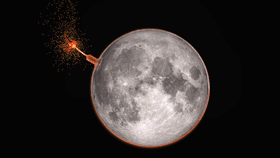


What would happen if we blew up the Moon? It drags along oceans creating the tide, it alters our tilt, but do we really need it? One professor from America thought absolutely not.
Destroying the Moon was mathematics professor at Iowa State University Alexander Abian’s unconventional cure all for life’s struggles, as he believed that blowing up our planetary pal would solve virtually every problem of human existence. He put forward this Moonless Earth Theory in 1991 in a campus newspaper.
“You make a big hole by deep drilling, and you put there atomic explosive,” People reports Abian wrote. “And you detonate it – by remote control from Earth.
Using nuclear weapons to blow up problematic things in space, as some have posited, could be an approach to get rid of any pesky asteroids that look set to do us in like they did the dinosaurs. The blockbuster movie Armageddon saw oil driller Bruce Willis and his band of merry men do just that, but the approach has been touted outside of Hollywood.
Keeping an eye on “Near Earth Objects” (NEOs) is something consultant on Don’t Look Up and Professor of Planetary Science Dr Amy Mainzer does with NASA. As principal investigator of NASA's Near-Earth Object Wide-field Infrared Survey Explorer (NEOWISE) mission, she and her team use a space telescope to hunt for asteroids and comets, including those that could pose a threat to Earth.
Preparing for NEOs is something the US, Russia, and the EU have jumped to following a problematic meteoroid that hit Chelyabinsk, Russia, in 2013, injuring around 1,500 people. Nuclear weapons are considered by some to be our best defense, and the Independent reported the US and Russia had been in talks about collaborating on a nuclear planetary defense initiative.
However, blowing up the Moon is on nobody’s radar. Why might one even contemplate the idea? According to Abian, it would be a way of moderating the weather.
He figured a moonless Earth wouldn't wobble, by which he means the 21,000-year-cycle altering the Earth’s tilt. This, in Abian’s world, would eliminate the seasons meaning tricksy topical weather events like hurricanes, floods, wildfires, and blizzards wouldn't bother us anymore.
Sounds good, right? But unfortunately – if that bunch at NASA are to be believed – it would all end in tears. The way they see it, blowing up the nearest planet to us would probably result in a sizable NEO in the form of a wedge of Moon that would slam into Earth eliminating all life.
Arguably, it would solve all of our problems, just not quite in the way Abian was hoping. However, the dreamer wasn’t deterred by his naysayers.
"Those critics who say, 'Dismiss Abian's ideas' are very close to those who dismissed Galileo," he’s reported to have said.