Space and Physics
 PUBLISHED



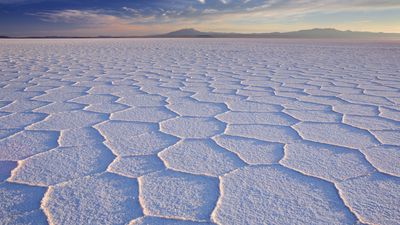


Salt deserts are unique environments on Earth – so unique, they almost appear otherworldly. The most striking feature in their appearance is how they are tiled with hexagons and other polygonal shapes covering their surface as far as the eye can see. And how these patterns appear might finally have been understood.
In the past, scientists had considered two possible explanations for the formation of this irregular honeycomb pattern. One possibility saw the pattern emerging from cracks. You start with a drying salty crust, and then a crack appears as it dries. The crack spreads, splits into multiple ones, and eventually, they form a pattern. Alternatively, the crust is constantly growing, and due to lack of space, it bends into the observed pattern.
A team of researchers was not satisfied with these possibilities, as they lack explanatory power to describe why the pattern is so geometrical and why the tiles are so large – always between 1 and 2 meters. Their idea has to do with the convection of saline water.
“This is a great example of curiosity-driven basic research. Nature presents us with an obvious and fascinating puzzle that stimulates our curiosity and thereby prompts us to solve it – even without any direct further possibility of application in mind,” first author Dr Jana Lasser from TU Graz said in a statement.
Their approach combined lab experiments recreating similar conditions, field trips to California’s Death Valley, and computer simulations. They wanted to understand how salty water moves in soil. These deserts, in fact, might have briny water just inches below the crust. As the surface gets hotter and water evaporates, the water right beneath it gets saltier and sinks down towards the less salty groundwater. Saltier water is heavier.
If there was a single convection roll, you’d get a circular shape. But many convection rolls develop next to each other and as they squeeze and push one another, they end up forming a honeycomb pattern.
“In salt deserts the first thing you see – almost the only thing you see – is an endless patchwork of hexagons and other ordered shapes. Some 50 million tourists have visited these patterns at Death Valley alone, and the fantastic landscape demands an explanation,” Dr Lucas Goehring, Associate Professor in Physics in Nottingham Trent University’s School of Science and Technology, added.
“What we’ve shown is that a simple, plausible explanation is there, but hidden beneath the ground. The surface patterns reflect the slow overturning of salty water within the soil, a phenomenon somewhat like the convection cells that form in a thin layer of simmering water.

The study is published in Physical Review X.

 1
1