Humans
 PUBLISHED
 2
2


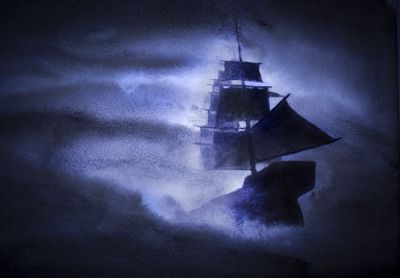


On December 5, 1872, the British ship Dei Gratia was sailing east of the Azores in the middle of the Atlantic when it came across an American merchant ship, the Mary Celeste, drifting silently through the ocean without a soul on board. Stranger still, the cargo was untouched, the crew's personal belongings were undisturbed, and the ship showed no signs of damage or struggle. All 10 people aboard — Captain Benjamin Briggs, his family, and the crew — had vanished without a trace.
For decades, the Mary Celeste stood as the archetypal ghost ship tale of the 19th century. Many theories were put forward, from pirate raids and freak weather to a disease outbreak and a mutiny. Rumors of extraterrestrials or some form of supernatural intervention were also floating around, often with little evidence.
In more recent times, scientific methods have been brought in to tackle this enduring maritime mystery. While questions remain, much of this research reinforces the idea that a boozey explosion of alcohol vapor may have been responsible for the crew's fate.
This would make sense considering the ship was transporting over 1,700 barrels of strong ethanol in its hold and an inquest of the salvaged ship later found nine barrels entirely empty. Inspectors suggested up to 300 gallons of the highly volatile ethanol could have seeped out of the porous wood used for the barrels and vaporized in this enclosed space (the hatches had been battened down due to rough weather). Pure ethanol has a flash point of 13°C (55°F). At or above this, the liquid produces enough vapor to form a flammable mixture with air. As the ship left the freezing waters of New York and entered the much warmer seas near Portugal, the temperatures would have risen and vapor would have increased. It would only take a spark to go up.
However, the explanation was long dismissed because no burn marks were found on the wooden cargo barrels or anywhere else in the hold. Nevertheless, some evidence suggests that the absence of scorching may not rule out an explosion after all.
Back in 2006, chemists at UCL carried out an experiment for the British TV channel Channel 5 in which they built a replica of the Mary Celeste’s hold. Using paper cubes and butane gas, they simulated the wooden barrels exploding due to alcohol vapor leaking from the ship's cargo. Once lit, a ball of flames went up, yet crucially, none of the paper cubes were burnt, damaged, or blackened.
"What we created was a pressure-wave type of explosion. There was a spectacular wave of flame but, behind it, was relatively cool air. No soot was left behind and there was no burning or scorching,” Dr Andrea Sella, a chemist at UCL, said in a statement at the time.
"Given all the facts we have, this replicates conditions on board the Mary Celeste. The explosion would have been enough to blow open the hatches and would have been completely terrifying for everyone on board,” he added.
"It is the most compelling explanation.”
Now, in 2026, the same hypothesis has been tested by another team of scientists to see if the theory holds up. Once again, it's been carried out for a Channel 5 documentary, a channel that seems particularly invested in this story.
Using wood and ethanol instead of Sella's paper and butane and a 1:18 scale model of the ship, Jack Rowbotham and Frank Mair from the University of Manchester showed how an explosion of ethanol vapor could have left no physical traces on the Mary Celeste, yet been more than enough to cause the crew to “jump ship” in a panic.
First they recreated the weather and temperatures. They sprayed cold ethanol into the hold to recreate the cold New York waters and used an electrical wire to start a spark. Nothing happened, the temperatures prevented the ethanol from producing enough vapors.
Next they recreated the more balmy temperatures of the Atlantic near the Azores by warming the ethanol and the wooden ship. This time, the spark took and a violent explosion ripped through the model before disappearing.
They suspect that a spark, perhaps from someone lighting a pipe or two pieces of metal striking together, ignited the fumes and produced a ball of blue flame reaching around 2,000°C (3,632°F), though only for a matter of seconds. Imagine a bartender setting a shot alight, or a chef flambéing a dessert. The fire consumes the gas from the alcohol but doesn't destroy the drink or dessert.
“When you’ve got the crew of a ship who would probably not have been quite so educated, then the idea that, in the darkness, you suddenly get a blue flash and heat, and all the doors open – that’s terrifying,” Sella recently told Chemistry World, commenting on the latest experiment.
It's possible the Captain ordered everyone into lifeboats, fearing more explosions, and the boat somehow got separated from the ship, or people jumped overboard in panic.
So, is that finally the case closed? Science always reserves the right to revise its conclusions when new evidence emerges, but until someone turns up hard proof of extraterrestrial ship enthusiasts, we’d hedge our bets on the boozey explosion theory.