Space and Physics
 PUBLISHED
 3
3




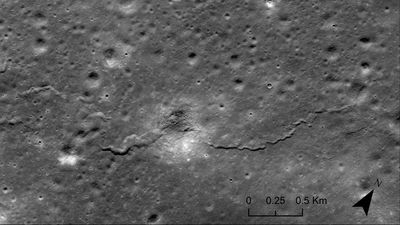


No other world in the solar system has tectonic plates and quakes like Earth, but it doesn’t mean that their ground doesn’t shake. Since the Apollo era, we have known there are moonquakes, and for about a decade and a half, we have known that the Moon is shrinking, losing 50 meters (165 feet) in its radius over the past 200 million years. Now, new evidence strengthens those findings.
The Moon used to be a lot more geologically active, but with time, its interior began to cool down and solidify. As the inner layer contracts, the crust cracks and buckles. Fault cliffs related to this process, called lobate scarps, were identified by Tom Watters and colleagues in the lunar highlands, the bright light-grey regions of the Moon.
New observations of the Moon have now found small mare ridges (SMRs), faults located in the lunar maria, the dark basalt plains of the Moon. These are what we normally call seas, such as the Sea of Tranquility, where Apollo 11 landed.
The team completed a catalog of SMRs, finding 1,114 new ones, bringing the total to 2,634. Both SMRs and the lobate scarps are close in age; an average of 124 million years old and 105 million years old, respectively. The team also found that the two are often physically connected as the terrain transitions from the highlands to the maria. The contractional activity of the Moon is most likely responsible for both.
“Our detection of young, small ridges in the maria, and our discovery of their cause, completes a global picture of a dynamic, contracting moon,” co-author Watters, senior scientist emeritus at the Center for Earth and Planetary Studies, said in a statement.
“Since the Apollo era, we’ve known about the prevalence of lobate scarps throughout the lunar highlands, but this is the first time scientists have documented the widespread prevalence of similar features throughout the lunar mare,” added lead author Cole Nypaver, also at the Center for Earth and Planetary Studies.
“This work helps us gain a globally complete perspective on recent lunar tectonism on the moon, which will lead to a greater understanding of its interior and its thermal and seismic history, and the potential for future moonquakes.”
Future human and robotic exploration of the Moon could bring new and more detailed insights into the activity that goes on inside it. The Artemis Program aims to have humans on the surface by the end of the decade (although there are complications with this). Artemis II will hopefully launch in a few weeks, and that will take humans around the Moon to see areas no human has seen before.
“We are in a very exciting time for lunar science and exploration,” Nypaver continued. “Upcoming lunar exploration programs, such as Artemis, will provide a wealth of new information about our moon. A better understanding of lunar tectonics and seismic activity will directly benefit the safety and scientific success of those and future missions.”
A paper describing the findings was published in The Planetary Science Journal.