Space and Physics
 PUBLISHED
 10
10



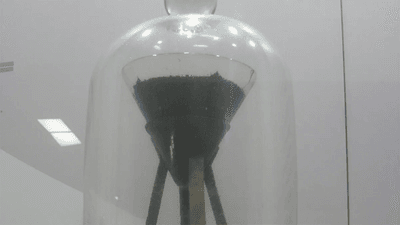


At the University of Queensland, there is a display containing the longest-running laboratory experiment in the world. It's been going for so long that two of its custodians have died before seeing any results, but now the experiment is nearing two key milestones: its 100th year, and its tenth "drop".
The pitch drop experiment was initiated in 1927 by Thomas Parnell, the University's first professor of physics. Intended as a demonstration of highly viscous materials, Parnell took pitch – residue from the distillation of coal tars – warmed it, placed it into a sealed glass funnel, and then waited three years for it to settle to the shape of the container. That might seem like a long time to wait for an experiment to even begin, but given the planned length of the demonstration, it was merely a long blink.
In 1930, Parnell cut the funnel's stem, allowing the highly viscous liquid to slowly flow out of the bottom. The experiment has been running ever since, incredibly slowly. The first drop fell eight years after the stem was cut, with a further five dropping over the next 40 years.
The setup has now been running for nearly 100 years and has been under the charge of several custodians. Parnell and his successor Professor John Mainstone both died without seeing a drop fall for themselves. The current custodian is Professor Andrew White. Nearly a century after the experiment began, we have only had nine drops fall so far.
The ninth drop, which took place in 2014, was marred by whatever passes for "controversy" in the pitch drop experiment world. While the drop formed, it began to make contact with the drops below, which were still contained in a beaker. White attempted to switch the beaker before the drops fused, but this caused the base to wobble and the ninth drop to snap off before its time. You can see the drop forming here, in heavily sped-up footage.
So, can the experiment tell us anything interesting?
Despite being less controlled than is ideal (it is subject to the fluctuations of room temperature, and the internal diameter of the stem cannot be accurately measured without the risk of damaging the experiment) it has a few surprises for us. Taking a number of factors into account, it is possible to make a reasonable estimate of how viscous pitch is.
"The viscosity of pitch is then calculated as q = (2.3 +0.5) x 108 Pa s, which is enormous compared to that of common liquids," a paper on the experiment explains. "Water at 20°C has a viscosity of 1.0 x 10⁻³ Pa s. It should be noted however that (ignoring superfluidity) it is close to the geometric mean of the range of values that physicists consider – the effective viscosity of the Earth is of the order of 1020 Pa s."
But this doesn't fit well with previous predictions.
"The result for the viscosity from the pitch drop experiment does not agree well with the predictions based on [previous] measurements, even allowing for the enormous variation of viscosity with temperature and the rather unknown temperature history of the experiment," the team writes. "The probable explanation lies in the differing viscosities of different samples of pitch – these could have dissimilar proportions of trapped volatile hydrocarbons and this would affect the viscosity."
If you'd like to watch the experiment live, you can. Currently, there is a pretty big blob forming, and it is looking "close" to the tenth drop dropping.
We wouldn't watch for too long though. Since the 1990s, the gap between each drop has increased to around one every 8 to 13 years, so while the pitch could drop again this year, it's possible you could be waiting until 2027 – the hundredth year of the experiment – for the tenth drop to occur.
An earlier version of this article was published in May 2024.