Nature
 PUBLISHED




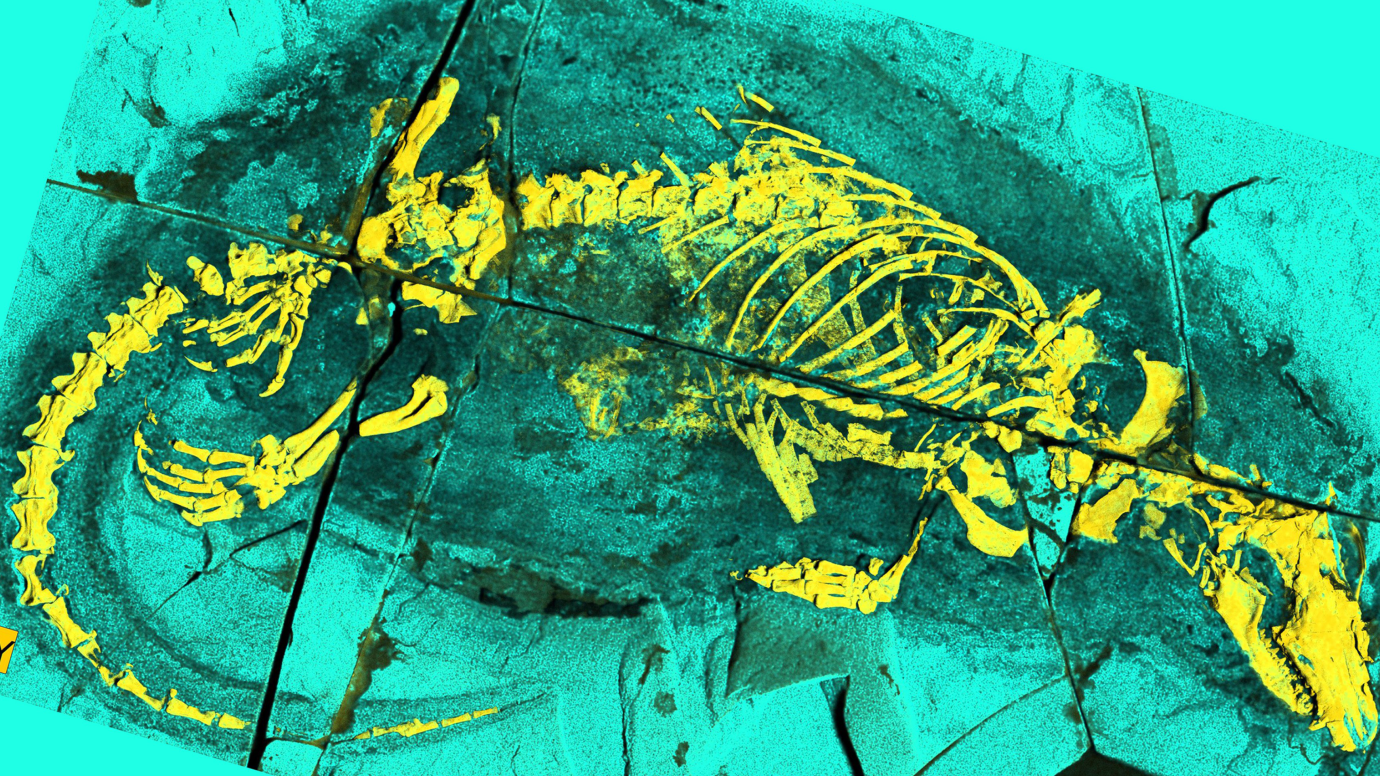
A gorgeous new fossil of an early mammal relative is giving scientists an astonishing insight into how our own ancient ancestors may have evolved over 165 million years ago.
The new fossil has been named Megacauda sungei. Not only is it the largest mammaliaform found from the Jurassic so far, but the exceptional preservation is showing researchers how the soft palate evolved, a key innovation for mammals that allowed for the evolution of suckling milk.
The ancient animal is what is known as a docodont. This evolved as a group before true mammals, which includes you and me, along with marsupials like kangaroos and monotremes, such as platypuses and echidnas.
The fact that it sits just outside true mammals, but already has evolved a complex soft palate, shows that this innovation was already in place when our own ancestors started to evolve. This may have allowed them to develop diverse ways of eating and exploit new environments.
“Docodonts are the most speciose group of the stem mammals across North America, Europe, and China, and this is probably one of the two most complete specimens for the group,” said Zhe-Xi Luo, from the University of Chicago, in a statement.
“This fossil shows that the intricate structures of the throat are starting to come together, long before modern mammals split off from their predecessors, and they are very important to the evolutionary innovation that underlies later adaptive radiation.”
An alternative Jurassic Park
Go back 165 million years and the landscape of Inner Mongolia would have looked vastly different.
Freshwater rivers would have crossed through forests containing some of the earliest redwood trees, while long-snouted pterosaurs soared overhead. Among the ferns, small, feathered dinosaurs would have dashed, picking off the little reptiles and amphibians scuttling through the leaf litter.
Walking along the banks of one of these rivers, there might have been the splash of a tail as an early mammaliaform made a dive to escape.
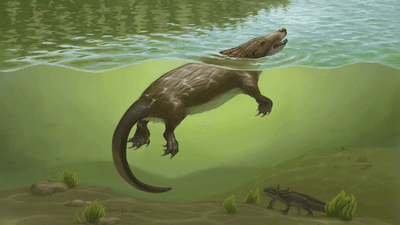
The animal would have looked something like a cross between a platypus and an otter.
It had a tapered snout full of sharp, shearing teeth, a thickset, furry body with powerful hind legs with webbed feet, and a long, slightly flattened tail covered in scaly skin. In modern mammals, these are the perfect adaptations for swimming.
This all points to a semi-aquatic lifestyle. It seems likely that the early mammaliaform would have lived on – or possibly even in – the banks of rivers where it would slip into the water and dive down to hunt other aquatic animals such as salamanders, in a very similar way to platypuses, otters, and minks.
Laying the groundwork for mammals
The extraordinary thing about this new fossil is that it not only preserved the bones of the animal, but also a good deal of its soft tissue.
This includes the outline of shaggy fur around its body, and importantly the internal structures of the mouth and throat. This shows researchers that even at this stage of mammaliaform evolution, Megacauda had a soft palate and a complex hyoid bone that aided in swallowing.
This adaptation allows mammals to take off small chunks of food and chew them before swallowing, whilst still being able to breathe through the nose. This is in comparison to other animals, such as crocodiles, which have to swallow large pieces of food while tossing their heads back.
“This is an incredibly important evolutionary innovation,” explains Luo. “After mammals chew their food, be it plants or meat, they all swallow it in the same efficient and effortless way.”
“Once early mammals had this apparatus, each group could develop specialized teeth and diversify into a tremendous range of food resources. They could be carnivores, insectivores, herbivores, omnivores, or anywhere in between.”
But not only that, because the soft palate and complex hyoid structure also play a key role in the ability for young mammals to suckle their mothers for milk, allowing them to drink even when upside down.
“It was this adaptation that made brain development, eventually leading to humans, possible,” said Professor Dr. Thomas Martin from the University of Bonn in another statement. “The soft palate and the shaping of the oral cavity and pharynx are directly linked to the evolution of mammals.”
The study is published in the journal Nature.