Space and Physics
 PUBLISHED


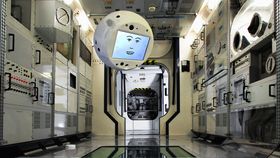


Meet CIMON, the friendly floating robot that's joining the crew onboard the International Space Station (ISS) later this year.
CIMON, short for Crew Interactive Mobile Companion, is a bit like a 3D-printed super-charged ALEXA built for space. Equipped with a digital face, voice, camera, and artificial intelligence (AI), the robot will be helping astronauts carry out their experiments while also serving as a companion to the crew.
“In short, CIMON will be the first AI-based mission and flight assistance system,” explained Manfred Jaumann, Head of Microgravity Payloads at Airbus, who helped develop CIMON alongside IBM, in a statement. “We are the first company in Europe to carry a free flyer, a kind of flying brain, to the ISS and to develop artificial intelligence for the crew on board the space station.”
CIMON is powered by IBM Watson technology, a computing system that can understand complex human language through automated reasoning and machine learning, allowing it to communicate with its fellow astronauts and cosmonauts. CIMON has learned all of the procedures that need to be carried out in the ISS, so it's well-equipped to help them out with any questions they might have.

On top of this, CIMON is blessed with a sense of emotional intelligence, so it's hoped it will be able to reduce some of the everyday stress felt by the crew too.
"CIMON is a personal assistant capable of voice and facial recognition. We want to study the psychological effects of long space missions on crew members and try out suitable countermeasures, especially those that reduce stress," added Till Eisenberg, project leader. "We will place special emphasis on data mining and interactions between humans and AI."
CIMON will be launched up to the ISS in June alongside German astronaut Alexander Gerst. The first part of the mission is a bit of a test run, so its capabilities will be limited. However, it will hopefully be ramped up to full capacity if all goes well. Airbus noted that it could be used on a “long-term missions to the Moon or Mars” in the future.
It will also get a taste of space in the following weeks when scientists test out its zero-G abilities onboard a parabolic “vomit comet” flight.
Last year, researchers sent up another ball-shaped experimental robot to the ISS, the oh-so-cute (although not as smart) Int-ball, whose primary job is to help the crew document their experiments. One of CIMON´s exercises on the International Space Station ISS will involve a Rubik´s Cube.