Humans
 PUBLISHED




Queen Meret-Neith was one of the most powerful women in the world during her lifetime and perhaps even the first woman pharaoh of Ancient Egypt. Little is known about her story, but her extravagant tomb certainly suggests she had immense power – and a taste for booze.
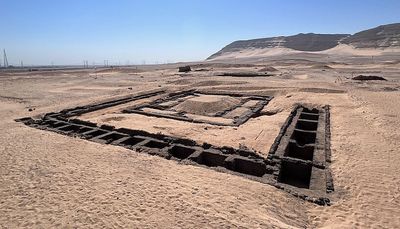
Recent excavations at the Abydos archaeological site have unearthed the tomb of Queen Meret-Neith who played a prominent role in Ancient Egypt’s First Dynasty around 3000 BCE.
The dig was part of a collaboration between the Egyptian Ministry of Tourism and Antiquities, the German Archaeological Institute in Cairo, the University of Vienna and the Vienna University of Technology in Austria, and Lund University in Sweden.
Among the sprawling tomb complex is the queen’s burial chamber, built of unbaked mud bricks, clay, and wood, which is surrounded by the tombs of 41 courtiers and servants.
Meret-Neith and her court were evidently big drinkers. The international team of archaeologists managed to recover a huge number of grave goods, including hundreds of well-preserved wine jars. Some have these vessels remain sealed and still contain the remains of the 5,000-year-old tipple. Talk about old-world wine.

Very little is known about the epoch of Meret-Neith. This was around 500 years before the Great Pyramid of Giza was constructed and marks a time when Egypt was only just rising to the prominence it would later hold. As such, records and hard historical evidence are limited.
Despite her apparent status, many scholars previously believed that Meret-Neith could not have held the throne as the full sovereign of Egypt, owing to the fact she was a woman. The exact roles and titles of rulers during the Early Dynastic Period is a complex matter, so many assumed she merely became the queen regent because she married a male king.
However, it’s become broadly accepted that she may have been the first female pharaoh and potentially history’s first recorded queen regnant (as in, a true female monarch who is equivalent in rank and title to a king).
“It would be pointless to deny further the place as the first woman pharaoh of Ancient Egypt to Meret-Neith,” Jean-Pierre Pätznick, a French Egyptologist, wrote in a 2015 publication by Proceedings of the Seventh European Conference of Egyptologists.
“She was a princess, a queen, a royal mother and a regent with an extraordinary destiny. For the very first time in history, Meret-Neith became, for a while, the equal of Egypt’s male pharaohs if not more,” he added.