


 Space and Physics
 PUBLISHED


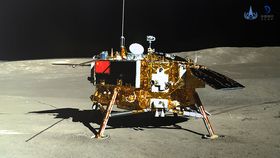


The rover and lander of the Chang’e-4 probe have woken up after their first lunar night, which lasted 14 Earth days. The two robotic missions were awoken by sunlight hitting them and started reporting back to Earth. But they didn’t stay idle when sleeping, they collected some data and showed that the Moon is colder during the night than previous measurements have indicated.
Data from the Apollo mission on the near side of the Moon put the minimum temperature at roughly -170°C (-274°F), but on the far side where the lander and rover, which is called Yutu-2 (Jade Rabbit-2), are located, the temperature was measured at -190°C (-310°F). The team believes that a difference in lunar soil composition might explain why it is much colder there. More analysis is needed to establish exactly what is going on.
We might often think of the Moon as having a monolithic climate, extremely hot during the day, freezing during the long night, but there are variations thanks to the geology. For example, one of the coldest natural places in the Solar System is on the Moon. In deep craters, where the Sun never reaches, the temperature is no higher than a few dozen degrees above absolute zero.
Currently, the rover is located 18 meters (59 feet) away from the lander. The landing location has a lot of small craters, which could make the rover’s exploration more challenging, although possibly more rewarding. The mission aims to study the terrain landforms and their composition, and examine what the shallow lunar surface is like. Yutu-2 will begin experiments in the Von Karman Crater.
"The far side of the Moon has unique features, and has never been explored on site, so Chang'e-4 might bring us breakthrough findings," Zou Yongliao, director of the lunar and deep space exploration division of the Chinese Academy of Sciences, said in a statement.
Chang’e-4 is one of the flagship missions of the Chinese National Space Agency and uses instruments developed by scientists in Sweden, Germany, the Netherlands, and Saudi Arabia. The previous Chinese mission to the Moon, Chang’e-3, has now survived 60 lunar nights and it is still going strong.
[H/T: China Daily]



 1
1