Health and Medicine
 PUBLISHED





Our chance to speak up is snuffed out when we die, but fortunately we have advocates willing to spill the beans on our behalf: our bodies. In the hands of forensic experts, the human body can reveal all kinds of secrets – not just about how we died, but also about how we lived.
Our bones and teeth act as archives of where we grew up and what we ate. Our hair records if we were exposed to toxins or extreme stress and can even contain biomarkers of illness. Then, there’s the lymph nodes.
In life and good health, our lymph nodes look like greyish-pink or greyish-cream beans – though you hopefully won’t have the misfortune of being able to verify that given they sit under the skin. Their goal: to filter out harmful substances, cancer cells, and pathogens so we can stay healthy.
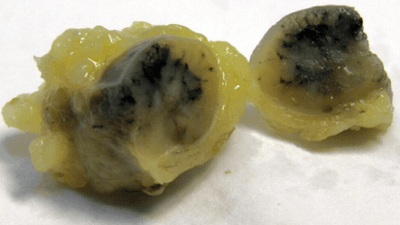
It’s a job that can take its toll, and anatomists have noted that corpses in their care occasionally arrive with unusually colorful lymph nodes, ranging from red to green to blue to black. So, what is the source of such strange coloration? Did these organs’ owners succumb to some kind of cancer?
That was the suspicion in a 2008 case study of a woman with melanoma of the thumb. Dark nodes elsewhere in her body led doctors to suspect the cancer had metastasized. The real culprit? Tattoo ink.
Tattoos are growing in popularity globally, but it’s an artform that comes with unique challenges. A 2023 study reported that in Europe, the rise in people getting tattoos has come with an associated rise in tattoo-related clinical complications.
For a recap, when we get inked, the tattoo artist introduces pigments to the dermis – the second layer of skin – where the ink gets trapped inside cells, allowing it to persist for decades. But that doesn’t mean some of the ink doesn’t spread elsewhere.
The lymphatic system drains into nodes that serve different parts of the body. This is why you might notice a lump appearing somewhere along your neck when you have a throat infection.
When tattoo ink gets inside a lymph node, it can cause inflammation and may even alter the body’s immune response to vaccination. That’s according to a 2025 study that saw a reduced response to COVID-19 vaccination and an enhanced response to influenza vaccination in experiments on mice.
That 2023 study I mentioned before found that tattooed skin was often associated with altered lymphatic drainage patterns, something that was observable by injecting dyes at tattoo sites and tracking how they traveled through the body. This can be relevant for investigations that rely on typical lymphatic drainage, such as cancer staging.
Black and blue tattoo ink can further complicate cancer investigations, as their presence in a node may mimic the blue dye used to find a sentinel node (the first one to drain fluid from a tumor area). This risks misidentification, as happened to a breast cancer patient in a 2018 case study, which could in turn lead to the removal of healthy nodes.
Tattoo ink can mislead scientists working with the living, but for those trying to read the dead, it can be an unexpected source of information. In some cases, murderers have tried to conceal the identity of the dead by removing identifying features such as tattoos. Out of sight, out of mind, but forensic anthropologists aren’t so easily fooled.
Evidence of tattoo ink in a lymph node left behind can reveal that a person had a tattoo, even if the inked bit of skin is no longer present. A bit of ink in a node might not seem like much, but forensic anthropologists are highly skilled in using seemingly minute details to reunite the deceased with their identity.
As for what tattoo ink means for the health of the living? A 2025 study into twins revealed it’s a complicated story.