Space and Physics
 PUBLISHED


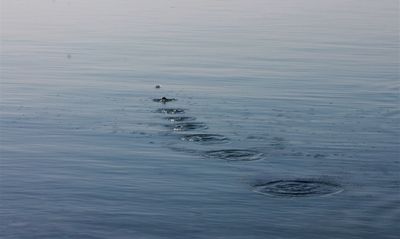


Stones skipping over water is one of the joys of holidays by lake or seaside, but it seems most of us have been doing it wrong for centuries, at least if you prefer quality of bounces over quantity. Generations of parents have taught their children different hand and arm movements, but most have agreed the flatter the rock, the better.
Sensible as this seems, in a new paper, mathematicians have proven the truth is more complex. The finding could have implications beyond giving an advantage in family stone-skimming contests. Asteroids have been spotted bouncing off the atmosphere like a skipped stone, and one even left a mineral trail over hundreds of kilometers from hitting the Earth at a low angle. The more we understand stones on water, the better placed we should be to anticipate how larger objects behave in circumstances that may prove rather important. Indeed, the stone-skipping discovery was an unexpected consequence of trying to make air travel safer.
Dr Ryan Palmer of Bristol University and Professor Frank Smith of University College London found that flat stones do indeed maximize the number of times a stone will skip. The reasons are probably what you would expect – a flat stone will face less air resistance if traveling in the right orientation, and will experience greater force from the water relative to its weight, improving the chance it will bounce.
However, Palmer’s computer modeling revealed stones with curved bottoms have their own attractions. They can experience a “super-elastic response” when they hit the water, causing them to rear up like a cricket ball off a grassy pitch. The horizontal velocity of the throw is turned into vertical velocity, providing a high bounce.
The study found there is a tradeoff between underside curviness and the extra mass, with the interplay determining how well it will skip. Even a body whose weight increases by a factor of eight “will still skip successfully provided its convex curvature is raised by a factor of 4,” Palmer and Smith write. Fat-bottomed rocks really do make the skimming world go round.
Palmer didn’t start off investigating stone-skipping. Instead, he was looking at the way ice crystals of varying sizes bounce off a layer of liquid that can form on aircraft wings, a topic far more likely to attract grants as it can affect whether wings ice up in certain conditions. The interactions turn out to be similar enough that the same modeling is useful for both. Another application the paper mentions is for landing airplanes on water, whether those designed for that purpose or in response to disasters such as the miracle on the Hudson.
Spin is often regarded as a key factor in effective stone skimming, but while the authors acknowledge its significance for the flights between bounces, they have not fully modeled it.
The study is open access and published in Proceedings of the Royal Society A.