Humans
 PUBLISHED
 4
4


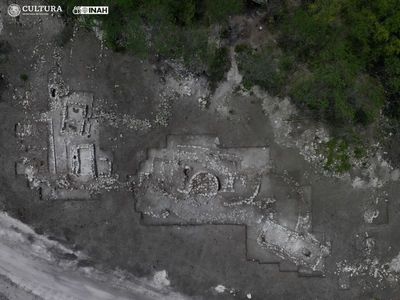


Archaeologists in southern Mexico have uncovered an ancient palatial complex that appears to have been dedicated to a terrifying Maya death god who ruled over a hellish realm, but was also the god of farts. Known as Ah Puch, or Cizin, the monstrous deity’s name has been translated as “stench”, “flatulence” and “The Stinking One”.
The discovery was made during the construction of a train station near the ancient Maya site of Calakmul, which was among the largest and most powerful pre-Columbian city states ever to exist in the Maya lowlands. According to the Mexican National Institute of Anthropology and History (INAH), the complex was most likely associated with a smaller settlement called Balamkú, which would have been heavily influenced by Calakmul.
Describing the find in a statement, the INAH reports that the complex probably dates to the Early Classic Period, which lasted from roughly 250 to 600 CE. Among the most notable structures present at the site is a small temple that researchers believe was built in honor of Old Stinky.
Excavations revealed the presence of a circular feature within the temple, at the center of which were a number of human remains, including teeth and fragments of skull. Alongside these grisly leftovers, archaeologists also found a 25-centimeter high (9.8 inches) limestone statue of Ah Puch.
The god of death and destruction, Ah Puch was believed to reign over a level within the Maya underworld, known as Xibalbá, which roughly translates as “the place of terror”. According to legend, the dreadful deity was responsible for burning the souls of the dead, beginning with their mouth and anus for some reason.
Providing more details about the new discovery, the INAH explains that the statue depicts Ah Puch with a “large phallus” and a deformed skull. The figure also appears to be sporting a skull mask, nose adornment, and breastplate, in accordance with the usual depiction of the death god.
The presence of this sculpture strongly indicates that the temple was intended as a place of ritual veneration for the flatulent divinity. One can only imagine how it must have smelled in there when the place was in use.