Space and Physics
 PUBLISHED



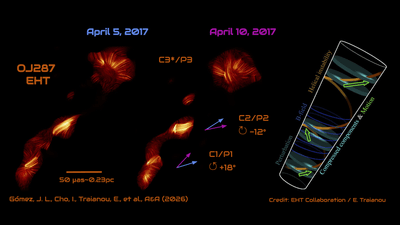


The Event Horizon Telescope (EHT) has done it again. During the observations that delivered the first images of the supermassive black hole at the center of our galaxy and at the center of elliptical galaxy M87, the team also looked much farther afield, delivering something we have never seen before. For the first time, astronomers have directly observed the interaction between shock waves and helical pressure waves in the jet of a supermassive black hole.
About 4 billion light-years from Earth is a pair of supermassive black holes orbiting each other in a system called OJ 287. The larger black hole is over 18 billion times the mass of our Sun and as wide as nine times the orbit of Pluto. The smaller is 150 million times the mass of the Sun and about six times as wide as Earth’s orbit. The small one goes around every 11 to 12 years, and this dance produces peculiar effects that have finally been captured.
In observations conducted between April 5 and April 10, 2017, the team looked at the relativistic jet produced by OJ 287, a powerful beam of energy. This system is not static, so while watching, the jet’s shape was changing, with several components shifting rapidly.
The EHT isn't a single telescope but a global network of radio telescopes that act as one the size of Earth. Thanks to its incredible resolution, equivalent to spotting a ping pong ball on the Moon, the team could see shock waves moving down the jet at different speeds that, when they interacted, created Kelvin-Helmholtz instabilities. These are phenomena associated with fluids, where velocity shear within one fluid can cause vortices. Jupiter's Great Red Spot could be caused by one such instability.
In this system, the instability manifests because the speed of the particles in the jet is very close to the speed of light, while the material around is moving a lot more slowly. This creates helical distortions, like the ones seen in the images. And these structures change as the jet moves.
"We observed substantial changes over five days," one of the paper's lead authors, Dr. Efthalia Traianou, AGN Working Group Coordinator for the EHT collaboration, said in a statement. "This is the first time we've directly observed this shock-instability interaction in a black hole jet."
The team was able to measure the jet at scales of 10-100 times that of the largest black hole radius, roughly 0.75 light-years. It is an incredible achievement to have been able to do that.
"These measurements let us directly trace the magnetic-field geometry in the jet’s launching and collimation region," added co-lead author Dr Ilje Cho from the Korea Astronomy and Space Science Institute.
The secret of the observation is the size of the Event Horizon Telescope. It is possible to use a technique called interferometry to create a radio telescope that is much bigger than your actual instruments separately. By connecting and synchronizing observatories across the surface of the Earth, from Europe to South America, Africa to Hawai’i, Greenland to the South Pole, you can build a telescope as big as our planet.
The study is published in the journal Astronomy & Astrophysics.