Space and Physics
 PUBLISHED


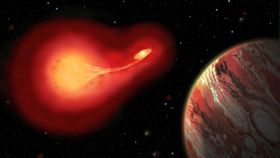


Old stars die in many different ways, but they all have one thing in common: They cause havoc for their nearby planets. But it turns out that if two stars are present, the planets in the system are more likely to survive.
An international team of researchers from NASA’s Goddard Space Flight Center and York University discovered that planets orbiting two-star systems are seemingly pushed outwards to safety when one of the stars turns into a red giant.
“This is very different from what will happen in our own Solar System a few billion years from now, when our Sun starts to evolve and expand to such a tremendous size that it will engulf the inner planets, like Mercury and Venus and possibly Earth too, faster than they can migrate out to larger orbits,” said lead author Veselin Kostov from NASA in a statement. “It seems that if we had a second star in the center of our Solar System, things might go differently.”
In a paper, published in the Astrophysical Journal, the scientists simulated nine different scenarios of circumbinary planets – those that orbit two stars (often called Tatooine planets after the famous world in Star Wars). They were surprised to discover that these planets are more likely to migrate outwards, in some cases twice as far as Pluto from the Sun, when one of the stars turns into a red giant.
Things can get even more complex when there are many planets in the system. Under those conditions, some planets will be ejected, some will switch places, and some could even be eaten by their parent stars.
“The reconfiguration can be quite dramatic when there are several planets,” said co-author Kevin Moore of York University in the statement. “Although all of the known circumbinary planets are gas giants, it is possible that somewhere out there is a terrestrial circumbinary planet that migrates to an orbit that now makes the planet potentially habitable for a little while.”
Binary stars are very common in the universe, so understanding their evolution is very important. After one becomes a red giant, the swelled envelope of gas can cover both stars, leading to either a dramatic mass loss for the system or a gigantic supernova explosion.