Space and Physics
 PUBLISHED
 3
3



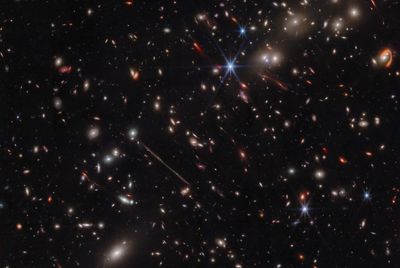


Did you have a heavy metal phase when you were a teenager? If the answer is yes, then you might have something in common with "teenage" galaxies. They too are into heavy metal: nickel. This surprising find is just one of several discoveries among galaxies that formed in the first 3 billion years after the Big Bang.
The team combined the light spectra of 23 out of 33 teenage galaxies observed last summer to create a composite picture of a standard young galaxy. This allowed them to highlight some shared compositional insights. The presence of eight elements literally shone through. Hydrogen, helium, nitrogen, oxygen, silicon, sulfur, argon, and nickel were detected.
“Never in my wildest dreams did I imagine we would see nickel,” lead author Allison Strom, from Northwestern University, said in a statement. “Even in nearby galaxies, people don’t observe this. There has to be enough of an element present in a galaxy and the right conditions to observe it. No one ever talks about observing nickel. Elements have to be glowing in gas in order for us to see them. So, in order for us to see nickel, there may be something unique about the stars within the galaxies.”
But it was not just the presence of nickel that was unusual. The galaxies tend to be at higher temperatures. Teenage galaxies' hot pockets are at over 13,350 degrees Celsius (24,062 degrees Fahrenheit), significantly higher than for galaxies in the current universe which are about 9,700 degrees Celsius (17,492 degrees Fahrenheit).
These galaxies were different. And we want to understand those differences and how they change over time. Together this will provide a more accurate picture of galaxy evolution through the ages of the universe.
“These teenage years are really important because that’s when the most growth happens,” Strom said. “By studying this, we can begin exploring the physics that caused the Milky Way to look like the Milky Way – and why it might look different from its neighboring galaxies.”
The observations were conducted by JWST as part of the CECILIA (Chemical Evolution Constrained using Ionized Lines in Interstellar Aurorae) Survey. The backronym honors Cecilia Payne-Gaposchkin, one of the first women to earn a PhD in Astrophysics. Her research allowed humanity to know what elements exist in stars and galaxies.
“Naming our JWST survey after Cecilia Payne-Gaposchkin was intended to pay homage to her pioneering studies of the chemical makeup of stars,” explained Gwen Rudie, a staff scientist at Carnegie Observatories who co-leads the CECILIA Survey with Strom. “Allison and I recognize that our own work revealing the chemistry of these very early galaxies is built upon her legacy.”
The study is published in The Astrophysical Journal Letters.