Space and Physics
 PUBLISHED
 1
1


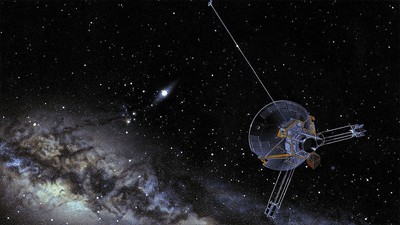


In 1972 and 1973, NASA launched the Pioneer 10 and Pioneer 11 probes. They were the first missions to Jupiter and Saturn, before heading to the asteroid belt and becoming the first two of five probes to reach the edge of our Solar System. With them, they brought a mystery which took quite a bit of explaining, and for a while hinted at new physics.
With such missions, NASA was of course expecting to hit some unknowns. Probes like Voyager 1 have had their own share of glitches, and sending back data that doesn't make any sense, and contacting a probe far out in the Solar System always comes with difficulties. But what NASA got from Pioneer 10 and 11 was a weird and intriguing mystery. At around 20 astronomical units (AU), with one AU being the average distance between the Earth and the Sun, both spacecraft underwent anomalous acceleration towards our Solar System's star.
"The anomalous acceleration of the Pioneer 10 and 11 spacecraft is a discrepancy between modeled and observed radio-metric Doppler data received from the two vehicles," a paper on the topic explains. "The discrepancy can be eliminated by incorporating a constant sunward acceleration of unknown origin."
The probes were still heading out of the Solar System, but a force was acting on them, pushing them in the direction of the Sun and slowing their progress. While this may sound trivial, the fact that both probes went through this at around 20 AU led some physicists to propose that there was something wrong with our theory of gravity, specifically Newton’s gravitational inverse-square law.
According to the inverse-square law, the gravitational force between two objects is proportional to their masses, and inversely proportional to the square of the distance between them. As such, you would expect the Sun's influence to weaken as you get further away from it, but data from these spaceships suggested otherwise.
Some tentatively suggested that it implied new physics, including the idea that the probes were not experiencing a force acting upon them, but that time passed differently for the probe due to the expansion of the universe.
"The acceleration aP is not related to any anomalous or unmodelled motion of the spaceships," one such paper suggested. "The anomaly is a manifestation of the expansion of the universe, which causes the increase of the background potential Ψ(t). This increase, in its turn, accelerates the cosmological time and causes the acceleration."
Others found tenuous support for their own hypotheses in the Pioneer anomalies.
"By using our model, we explain the numerical coincidence between the value of the anomalous acceleration and the Hubble constant at the present epoch and also confirm our previous determination of the cosmological parameters γ ∼ 10−28 cm−1 and δ ∼ 10−4 −10−5," one team wrote.
"We show that our conformal cosmology can naturally explain the anomalous acceleration of the Pioneer 10 and 11 spacecraft, in terms of a local blueshift region extending around the solar system and therefore affecting the frequencies of the navigational radio signals exchanged between Earth and the spacecraft."
That sounds pretty intriguing. If further probes had undergone similar acceleration towards the Sun, it could have been evidence that new, exotic explanations were necessary to explain what was happening. However, further probes did not undergo anomalous acceleration at the same distance.
The problem was likely due to the spacecraft themselves.
Decades later, after looking through recovered Doppler data, a much more mundane and likely explanation was discovered. The team found that "the anomalous acceleration of the Pioneer 10 and 11 spacecraft is due to the recoil force associated with an anisotropic emission of thermal radiation off the vehicles", and concluded that "once the thermal recoil force is properly accounted for, no anomalous acceleration remains".
Other anomalies are less easy to clear up, including the "flyby anomaly". While using gravity assists from planets in order to get to their various destinations, probes have undergone similar changes in acceleration, usually gaining a little more speed than scientists were expecting. The anomaly has been seen in Galileo, Cassini–Huygens and Rosetta as the spacecraft flew past Earth.
All sorts of explanations have been proposed for the flyby anomalies, such as an unexpected effect from the Earth's rotation, to a dark matter halo around Earth. However, other spacecraft have not been observed to undergo this same anomalous acceleration, leaving our influence at the expected velocity. Like with the Pioneer anomaly, the flyby anomaly will likely receive a more mundane explanation, though as yet the anomalies remain unexplained. We may learn more as we send more probes flying off into the cosmos and encounter the same effect, or be left with a mystery left by probes with unaccounted for heating problems.
Only time and more work by scientists will tell.