Space and Physics
 PUBLISHED



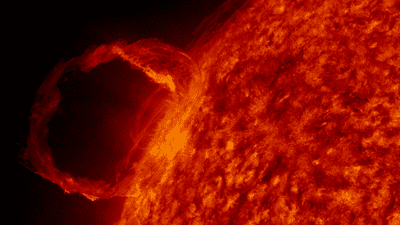


Professional photographer and science communicator Miguel Claro has created an incredible time-lapse video of the Sun flinging out a coronal mass ejection (CME) into space. Around one hour's worth of images captured in Portugal shows the motion of the plasma along the magnetic field lines.
The Sun’s cycle lasts around 11 years, going from a minimum of activity to a maximum. The maximum for this current cycle is expected to happen in July 2025, so the Sun is increasing its activity. And it seems this is going to be a particularly active cycle with reports of powerful flares and coronal mass ejections already coming in regularly.
The time-lapse created by Claro is from observations of the Sun from July 10 and shows a solar prominence releasing a coronal mass ejection into space.
“As soon as I realized that a huge prominence was visible and growing so fast and drastically, I quickly started shooting. The Sun was lower than ideal and the atmosphere had a fine layer of dust coming from Africa. The temperature was also very high, around 100 degrees Fahrenheit (38 Celsius) at 6:00 p.m. local time. So I made a huge effort to gather as many images as possible,” Claro wrote for Space.com.
The same event can also be seen from space thanks to NASA's Solar Dynamics Observatory, showing the prominence and coronal mass ejection being released.
[H/T: Space.com]